
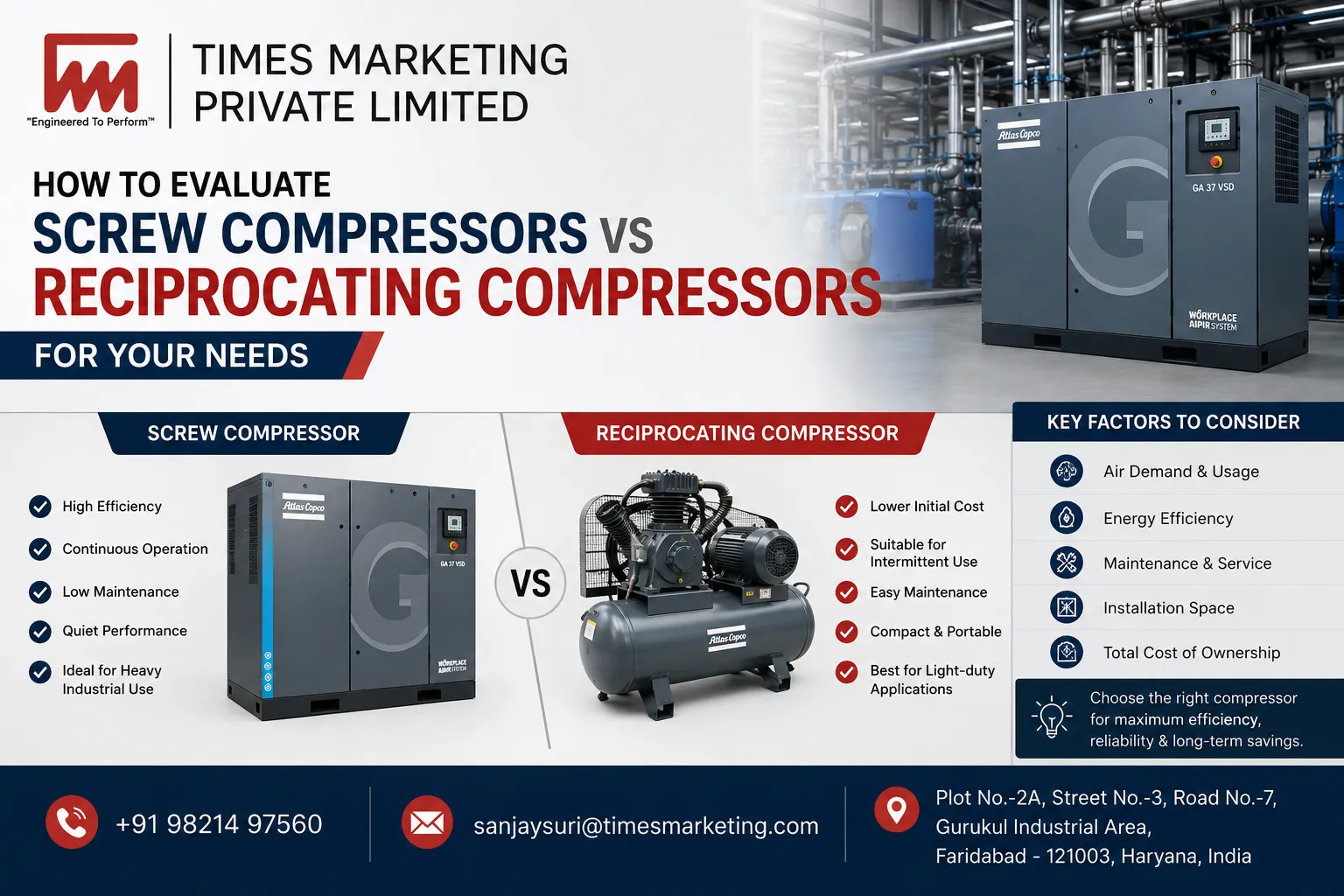
The screw compressor vs reciprocating compressor decision is not about which technology is universally superior. It is about matching compression technology to your plant's actual duty cycle, air quality requirement, and production demand. Get this decision right, and your compressed air system becomes a dependable background utility. Get it wrong, and you end up either overpaying for capability you do not need, or straining a machine that was never designed for your workload. This guide walks through exactly how to make that call correctly.
Two Fundamentally Different Compression Methods
Before comparing performance, it helps to understand what actually happens inside each machine, because the mechanical difference is what drives every downstream difference in efficiency, noise, maintenance, and suitability.
Reciprocating compressors use a piston moving back and forth inside a cylinder. As the piston moves down, it draws air in through an intake valve. As it moves back up, it compresses that air and pushes it out through a discharge valve. This is a batch process, air is compressed in individual strokes, which creates a naturally pulsating output.
Screw compressors use two helical rotors, one male and one female, that mesh together and rotate continuously. Air enters at one end, gets progressively trapped and compressed as it moves along the shrinking space between the rotors, and exits at the other end as a smooth, continuous stream. This is why rotary screw machines are often grouped under reciprocating and rotary compressor comparisons as the two dominant industrial compression technologies.
Key Takeaway: Reciprocating compressors compress air in pulses through mechanical strokes. Screw compressors compress air continuously through rotor meshing. This single mechanical difference explains nearly every practical distinction between the two.
Reciprocating vs Screw Compressor: Full Comparison Table
| Factor | Reciprocating Compressor | Screw Compressor |
|---|---|---|
| Compression Method | Piston stroke, batch process | Continuous rotor meshing |
| Air Delivery | Pulsating output | Smooth, continuous output |
| Ideal Duty Cycle | Intermittent use | Continuous, high duty cycle use |
| Noise Level | Generally higher | Generally lower |
| Maintenance Frequency | More frequent, more wear parts | Less frequent for continuous operation |
| Typical Capacity Range | Smaller to moderate | Moderate to large industrial capacity |
| Initial Investment | Usually lower for smaller capacities | Usually higher, but scales efficiently for larger demand |
| Best Suited Industries | Workshops, small fabrication, tyre shops | Manufacturing, automotive, pharma, food processing, textiles |
| Energy Efficiency at Continuous Load | Lower, due to duty cycle limitations | Higher, especially with VSD |
When a Reciprocating Compressor Is the Right Choice
Reciprocating compressors remain a practical, cost effective choice in specific scenarios. They tend to work well for:
- Small workshops with intermittent, low volume air demand
- Applications where air is needed in short bursts rather than continuously
- Facilities with a limited budget for initial equipment investment
- Simpler maintenance environments without dedicated technical staff
Did You Know? Reciprocating compressors are still widely used across small scale fabrication units and automotive service centers in India, precisely because their intermittent duty cycle suits the on demand nature of that work.
The tradeoff is that reciprocating machines are not built for continuous, high duty industrial operation. Running one beyond its intended duty cycle accelerates wear on pistons, valves, and rings, leading to more frequent breakdowns and shorter service intervals.
When a Screw Compressor Is the Right Choice
Rotary screw compressors are the standard recommendation for most industrial manufacturing environments where compressed air is required continuously across production shifts. They suit:
- Continuous, high volume industrial production lines
- Automotive, textile, pharmaceutical, and food processing facilities
- Environments requiring stable, pulsation free air pressure
- Operations looking to minimize energy waste through VSD (Variable Speed Drive) technology
Expert Tip: If your compressed air system runs more than a single shift per day, or if your production line cannot tolerate pressure fluctuations, a screw compressor is almost always the more reliable long term choice over a reciprocating unit.
Technical Fundamentals Every Buyer Should Understand
Whichever technology you are evaluating, a few core technical concepts determine whether the machine will actually meet your needs.
FAD (Free Air Delivery) is the actual usable air output of the compressor, measured under standard atmospheric conditions. This is the figure that matters far more than motor horsepower when comparing machines.
CFM expresses air delivery capacity in cubic feet per minute, commonly used alongside FAD in technical specifications.
Working Pressure (PSI or Bar) must match your connected equipment's requirements. Oversizing pressure wastes energy, while undersizing leaves your tools and machinery underperforming.
Oil Lubricated vs Oil Free. Both reciprocating and screw compressors are available in oil lubricated and oil free configurations. Oil free versions are essential for contamination sensitive industries like pharmaceuticals and food processing, regardless of which compression technology you choose.
VSD (Variable Speed Drive) is primarily available on screw compressors and adjusts motor speed to match real time demand, offering meaningful energy savings for facilities with variable air consumption.
Air Quality and ISO Standards. Depending on your industry, air purity requirements may need to align with recognized ISO air quality classifications, which affects your choice of filtration and drying equipment regardless of compressor type.
Energy Efficiency and Lifecycle Cost Considerations
Warning: Comparing reciprocating and screw compressors purely on upfront investment, without factoring in energy consumption and maintenance cost over the machine's operating life, is one of the most common and costly evaluation mistakes.
For continuous operation, screw compressors generally offer better energy efficiency because they avoid the frequent start stop cycling that reciprocating machines rely on to manage variable demand. Over a multi year operating period, this efficiency difference often outweighs the higher initial investment of a screw compressor, particularly for facilities running multiple shifts.
| Cost Factor | Reciprocating Compressor | Screw Compressor |
|---|---|---|
| Energy Cost at Continuous Load | Higher due to cycling inefficiency | Lower, especially with VSD |
| Maintenance Cost | More frequent part replacement | Less frequent for matched duty cycle |
| Expected Service Life at High Duty | Shorter if overworked beyond design | Built for continuous operation |
| Downtime Risk | Higher if used beyond intended duty cycle | Lower when correctly sized and maintained |
A Real World Sizing Mistake Worth Learning From
We once assessed a mid sized packaging unit that had been running two reciprocating compressors around the clock to keep up with a growing production line. The machines were undersized for continuous use, and the maintenance team was replacing valves and rings every few months just to keep production moving. The unit was essentially forcing equipment designed for intermittent work to perform like a continuous duty machine.
After a proper site assessment, switching to a single appropriately sized screw compressor eliminated the constant valve replacement cycle and delivered steadier pressure across the line. This is a common pattern: reciprocating compressors get pushed into continuous duty roles they were never designed for, simply because that was the equipment already on site when production demand grew.
Common Mistakes When Choosing Between the Two Technologies
Mistake 1: Assuming Cheaper Upfront Cost Means Better Value. A lower initial price on a reciprocating unit can be outweighed by higher energy and maintenance costs if the application actually calls for continuous duty.
Mistake 2: Running a Reciprocating Compressor Beyond Its Intended Duty Cycle. This accelerates wear and increases breakdown frequency significantly.
Mistake 3: Choosing a Screw Compressor for Very Low, Intermittent Demand. For small, occasional air use, a screw compressor may be an unnecessarily large investment compared to a simpler reciprocating unit.
Mistake 4: Ignoring Noise Considerations in Occupied Workspaces. Reciprocating compressors are generally louder, which matters in facilities where the compressor room is close to work areas.
Mistake 5: Not Accounting for Future Production Growth. Choosing based only on current demand, without room for expansion, often leads to premature equipment replacement.
Maintenance Comparison Between the Two Technologies
| Maintenance Task | Reciprocating Compressor | Screw Compressor |
|---|---|---|
| Valve Inspection | Frequent, critical wear component | Not applicable |
| Piston Ring Wear Check | Regular monitoring required | Not applicable |
| Airend and Rotor Check | Not applicable | Periodic, per manufacturer schedule |
| Oil and Filter Change | Frequent | As per manufacturer running hour intervals |
| Vibration and Noise Monitoring | Important due to reciprocating motion | Lower priority given smoother operation |
| Leak Testing Across Piping | Applicable to both | Applicable to both |
Expert Tip: Regardless of which technology you choose, tracking pressure drop across filters and monitoring for leaks across your piping network remains one of the most effective ways to control energy waste and catch developing issues early.
Buying Guide: Choosing Between Screw and Reciprocating Compressors
Step 1: Define Your Duty Cycle. Determine whether your air demand is continuous throughout shifts or intermittent and occasional.
Step 2: Calculate Actual Air Demand. Total your FAD requirement across connected equipment, including a margin for future growth.
Step 3: Identify Air Quality Needs. Decide whether your process requires oil free air, which is available in both technologies.
Step 4: Evaluate Noise and Space Constraints. Consider where the compressor will be installed and how that affects your choice.
Step 5: Compare Total Lifecycle Cost, Not Just Purchase Investment. Factor in energy consumption and expected maintenance frequency for your specific duty cycle.
Step 6: Consult an Experienced Supplier for Application Specific Guidance. A proper site assessment accounts for factors a catalog comparison cannot capture.
Step 7: Plan Installation and Commissioning Carefully. Correct piping, ventilation, and foundation work protect performance regardless of which technology you select.
Checklist: Screw or Reciprocating, Which Fits Your Plant
- Is your air demand continuous across shifts, or intermittent?
- Have you calculated actual FAD requirements, not just motor horsepower?
- Does your process require oil free air?
- Is compressor noise a concern for your facility layout?
- Have you factored in energy cost over the machine's operating life, not just upfront investment?
- Do you have future production growth to plan for?
- Have you consulted a supplier who can size the system to your actual site conditions?
Atlas Copco Compressors: Coverage Across Both Technologies
Atlas Copco compressors are available across both reciprocating and rotary screw technology, giving buyers the flexibility to select the right fit for their specific duty cycle rather than being limited to a single compression method. As an authorized supplier of Atlas Copco India equipment, Times Marketing helps facilities evaluate both options against their actual production requirements, rather than defaulting to a single recommendation regardless of application. Whether the right fit turns out to be a compact reciprocating unit for a small workshop or a full VSD rotary screw system for a continuous production line, the goal is matching the machine to the job.
Conclusion
The screw compressor vs reciprocating compressor decision ultimately comes down to matching compression technology to your actual duty cycle and production demand, not choosing based on habit or upfront cost alone. Reciprocating compressors continue to serve smaller, intermittent applications well, while screw compressors remain the stronger choice for continuous industrial operation where efficiency and reliability matter most. Taking the time to properly assess your air demand before choosing between the two protects both your production uptime and your long term operating costs.
Call to Action
If you are weighing a screw compressor against a reciprocating compressor for your facility, Times Marketing can help you make that decision with a proper technical assessment rather than guesswork. Our team can evaluate your actual air demand, recommend the right technology including genuine Atlas Copco compressors, and support you through installation and ongoing maintenance. Reach out to Times Marketing to schedule a consultation, request a tailored product recommendation, or arrange a site assessment for your plant.