
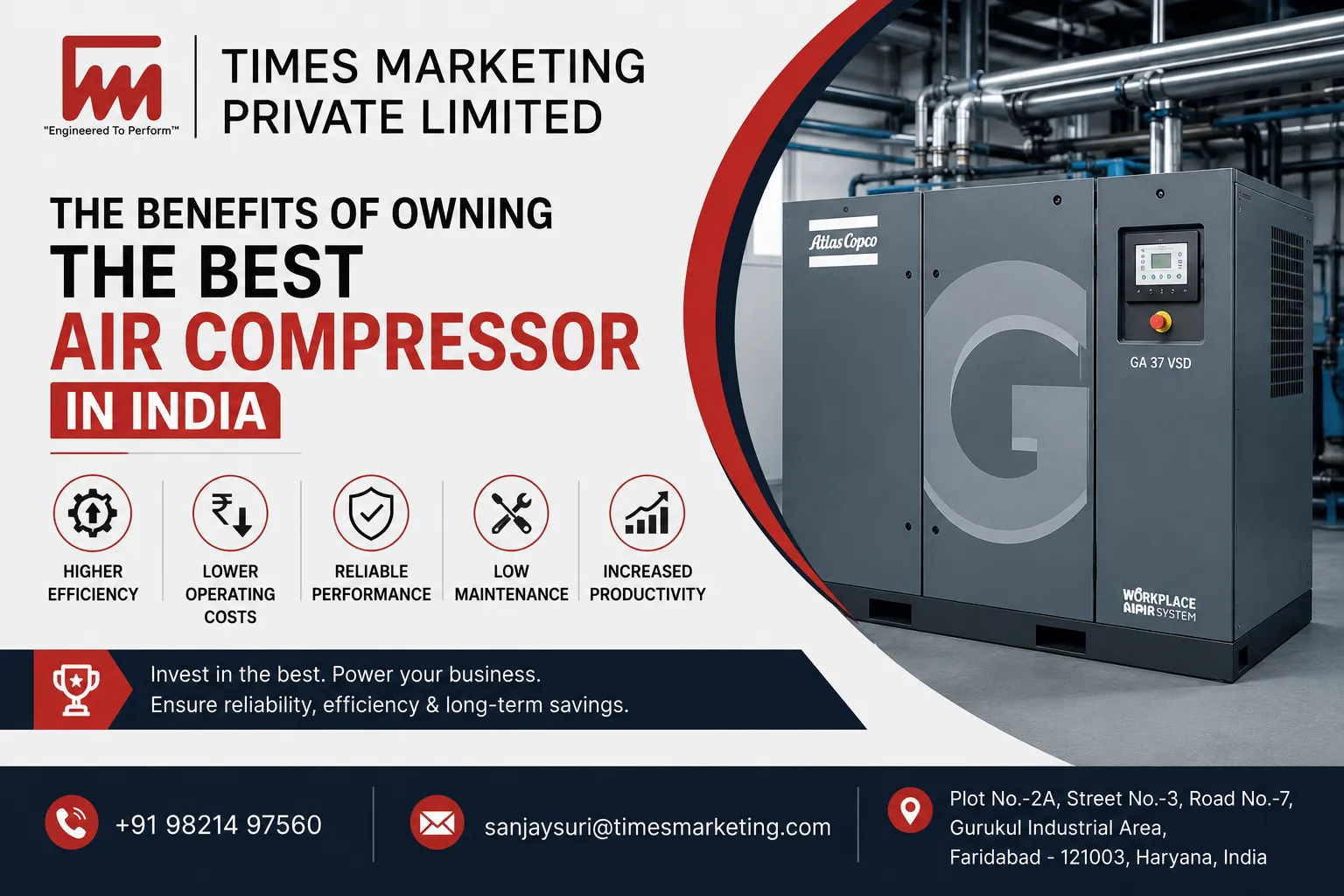
Owning the best air compressor in India for your specific application is not about buying the most expensive machine on the market. It is about matching the right technology, capacity, and air quality to your actual production needs, then backing that decision with proper installation and maintenance. When that alignment happens, the benefits show up everywhere, from your energy bill to your uptime record. This guide breaks down exactly what those benefits look like, and how to make sure you are choosing correctly the first time.
Why the "Best" Compressor Is Different for Every Plant
Before getting into benefits, it is worth clearing up a common misconception. There is no single top air compressor that works universally across every industry. A pharmaceutical cleanroom, an automotive stamping unit, and a small precision workshop each have completely different requirements for pressure, air purity, and duty cycle.
The best compressor for your plant is the one that:
- Delivers the correct FAD (Free Air Delivery) for your actual connected load
- Matches your required working pressure without oversizing
- Meets your air quality needs, whether that means oil free or properly filtered oil lubricated air
- Fits your duty cycle, whether continuous or intermittent
- Comes with dependable local service and genuine spare parts support
Key Takeaway: The right compressor is defined by fit, not by specification sheet size. An oversized machine wastes energy running underloaded, while an undersized one struggles to keep up and wears out faster than expected.
Benefit 1: Consistent Production Without Air Starvation
Compressed air is often called the fourth utility in a factory, right alongside electricity, water, and gas, yet it rarely gets the same attention until something goes wrong. A correctly selected compressor delivers steady FAD at your required pressure without dropping during peak demand, which means your pneumatic tools, actuators, and automated systems keep running without interruption.
We have seen plants where a single undersized compressor caused a domino effect across an entire line: pressure dropped, cylinders cycled slower, output per hour fell, and operators assumed the machinery itself was faulty when the real issue was upstream in the compressed air supply. Getting the sizing right at the outset eliminates this entire category of hidden production loss.
Benefit 2: Lower Energy Consumption Over Time
Compressed air generation is one of the more energy intensive processes in a typical industrial facility. Choosing an efficient, correctly sized compressor, particularly one with VSD (Variable Speed Drive) technology where your demand fluctuates, directly reduces the electricity consumed per unit of air delivered.
Quick Facts on Energy Efficiency
- Fixed speed compressors cycle between load and unload states, which can waste energy during partial demand periods
- VSD compressors adjust motor speed in real time to match actual air demand, reducing unnecessary power draw
- Leaks in piping networks are consistently identified in industry studies as a major, often underestimated, source of compressed air energy waste
- Correctly maintained filters and dryers reduce pressure drop, which in turn reduces the energy the compressor must expend to compensate
Energy efficiency is not just an environmental talking point. For most industrial facilities, electricity to run compressed air systems represents a recurring operational cost that compounds every single day the plant runs, making efficient equipment selection a long term financial decision as much as a technical one.
Benefit 3: Better Air Quality Protects Your Product and Equipment
For industries like pharmaceuticals, food processing, and electronics assembly, air quality is not optional, it is a compliance requirement. Even in general manufacturing, poor air quality, whether from moisture, oil carryover, or particulate contamination, can damage pneumatic components, corrode piping, and compromise finished product quality.
The best air compressor setup pairs the compressor itself with the right supporting equipment:
- Air Dryers remove moisture that would otherwise condense inside piping and tools, causing corrosion and malfunction
- Compressed Air Filters remove particulates and, in oil lubricated systems, residual oil vapor
- Air Receivers stabilize pressure fluctuations and reduce compressor cycling
Choosing a compressor without considering this full system is one of the most common gaps we encounter during site assessments. A high quality compressor paired with inadequate filtration or drying still results in poor air quality at the point of use.
Benefit 4: Lower Lifecycle Cost, Not Just Lower Upfront Investment
Warning: Focusing purely on the initial specification sheet while ignoring lifecycle cost is one of the most expensive mistakes industrial buyers make.
A compressor's true cost includes energy consumption, maintenance frequency, spare parts availability, and expected operating life, not just the machine itself. A well engineered compressor from a manufacturer with strong local support often proves more economical over a ten year operating period than a cheaper alternative that requires frequent servicing or lacks readily available parts.
| Cost Factor | Impact Over Compressor Lifetime |
|---|---|
| Energy Consumption | Typically the largest ongoing cost across the operating life of the machine |
| Preventive Maintenance | Reduces risk of major failures and unplanned downtime |
| Spare Parts Availability | Determines how quickly the plant recovers from a breakdown |
| Airend Durability | Affects frequency of major overhauls |
| Installation Quality | Poor installation can shorten equipment life regardless of build quality |
Benefit 5: Reduced Downtime Through Reliable After Sales Support
Even the best engineered compressor eventually needs servicing. What separates a genuinely dependable ownership experience is the strength of the after sales support behind it, including trained technicians, genuine spare parts, and realistic response times when something goes wrong.
A plant head we worked with once described the moment his previous supplier stopped answering calls after the sale as the day he realized the compressor purchase had been the easy part. Ongoing support is what actually protects your production uptime over the years that follow.
Understanding Compressor Technology Before You Choose
A basic technical grounding helps you evaluate any "best compressor" claim critically rather than taking it at face value.
Rotary Screw Compressors use two meshing helical rotors to deliver continuous, pulsation free air, making them the standard choice for most industrial continuous duty applications.
Piston Compressors compress air through a reciprocating piston mechanism, suited to smaller, intermittent use cases rather than continuous industrial demand.
Oil Free vs Oil Lubricated Compressors. Oil free systems eliminate any oil contact with compressed air, essential for contamination sensitive industries, while oil lubricated systems are generally more economical for standard industrial applications when paired with proper filtration.
VSD Technology adjusts motor speed to match real time demand, offering meaningful energy savings for plants with variable air consumption patterns.
Pressure Units. Working pressure is typically expressed in PSI or Bar, and matching this correctly to your equipment's requirements, without excessive margin, avoids unnecessary energy expenditure.
Atlas Copco Compressors in India: A Recognized Benchmark
Among the options available to Indian industrial buyers, Atlas Copco compressors are widely regarded as a benchmark for engineering consistency, backed by global manufacturing standards and a wide range covering rotary screw, oil free, and VSD technology. As an authorized supplier of Atlas Copco India equipment, Times Marketing provides genuine machines along with the technical guidance needed to select the right model, size it correctly for your facility, and support it through installation and ongoing maintenance.
That said, no brand name alone guarantees the right outcome. The ideal air compressor for your plant depends on your specific air demand, quality requirements, and operating environment, which is why a proper technical assessment should always precede a purchase decision, regardless of which manufacturer you are considering.
Comparison Table: What Separates a Genuinely Good Compressor Purchase From an Average One
| Factor | Average Purchase Decision | Strong Purchase Decision |
|---|---|---|
| Sizing Method | Based on catalog assumptions | Based on actual site air demand assessment |
| Air Quality Match | Generic filtration | Matched to specific industry requirement |
| Energy Consideration | Ignored at purchase | Factored into total lifecycle cost |
| Installation | Minimal planning | Proper piping, ventilation, and foundation design |
| After Sales Support | Uncertain or distant | Local, trained, and responsive |
| Spare Parts | Unverified sourcing | Genuine, traceable parts |
Common Mistakes When Choosing an Air Compressor
Mistake 1: Sizing Based on Motor Horsepower Alone. Horsepower does not directly translate to usable air delivery. Always request actual FAD figures at your required working pressure.
Mistake 2: Ignoring Future Capacity Needs. Buying a compressor sized exactly for today's demand often means a costly upgrade within a few years of plant expansion.
Mistake 3: Skipping a Proper Site Assessment. Ambient temperature, altitude, and dust levels all affect compressor performance and should factor into the selection process.
Mistake 4: Overlooking Filtration and Drying Needs. A compressor alone does not guarantee air quality without the right dryer and filter combination.
Mistake 5: Delaying Preventive Maintenance. Reactive maintenance, addressing problems only after they cause a failure, is consistently more expensive than a structured preventive schedule.
Maintenance Best Practices to Protect Your Investment
| Maintenance Task | Recommended Frequency | Purpose |
|---|---|---|
| Visual and audio inspection | Every shift | Catch early warning signs of leaks or unusual operation |
| Air filter check | Monthly | Maintain intake air quality |
| Oil and lubricant check | As per manufacturer schedule | Preserve internal lubrication performance |
| Leak testing across piping | Periodic | Reduce energy waste and pressure loss |
| Full technical service | As per running hours | Comprehensive inspection of critical components |
| Air quality verification | Per industry requirement | Ensure ongoing compliance with application standards |
Expert Tip: Track pressure drop across your filters and dryers over time. A gradual increase is often the earliest indicator that a component needs attention, well before it causes a noticeable performance issue.
Buying Guide: How to Choose the Best Air Compressor for Your Facility
Step 1: Calculate Actual Air Demand. Total the FAD requirement across all connected equipment, with a reasonable margin for future growth.
Step 2: Define Your Air Quality Requirement. Determine whether your process demands oil free air or can operate safely with properly filtered oil lubricated air.
Step 3: Assess Your Site Conditions. Factor in ambient temperature, dust levels, altitude, and available installation space.
Step 4: Evaluate Suppliers on More Than Price. Compare technical support, genuine parts availability, and after sales service alongside the equipment itself.
Step 5: Request an Application Specific Recommendation. Avoid relying solely on generic catalog specifications.
Step 6: Plan Installation Properly. Confirm piping design, ventilation, and foundation requirements before commissioning.
Step 7: Establish a Maintenance Routine From Day One. A consistent preventive maintenance schedule protects your investment for the long term.
Checklist for Choosing the Best Air Compressor in India
- Confirm actual FAD requirement at your working pressure
- Determine oil free versus oil lubricated suitability
- Evaluate whether VSD technology fits your demand pattern
- Assess ambient site conditions
- Verify supplier's genuine spare parts sourcing
- Confirm local service response times
- Request a proper site assessment before finalizing
- Plan for future capacity needs, not just current demand
Conclusion
Owning the best air compressor in India for your facility comes down to one principle: fit over flash. The real benefits, consistent production, lower energy consumption, better air quality, reduced lifecycle cost, and dependable uptime, all stem from choosing equipment that genuinely matches your plant's demand and operating conditions, then supporting that equipment with proper installation and ongoing maintenance. A compressor chosen this way pays for itself many times over through the disruptions it prevents.
Call to Action
If you are evaluating compressor options for a new installation, an upgrade, or a replacement, Times Marketing can help you make that decision with confidence. Our team can assess your actual air demand, recommend the right solution including genuine Atlas Copco compressors, and support you through installation and long term maintenance. Contact Times Marketing to schedule a consultation, request a tailored product recommendation, or arrange a site assessment for your facility.