
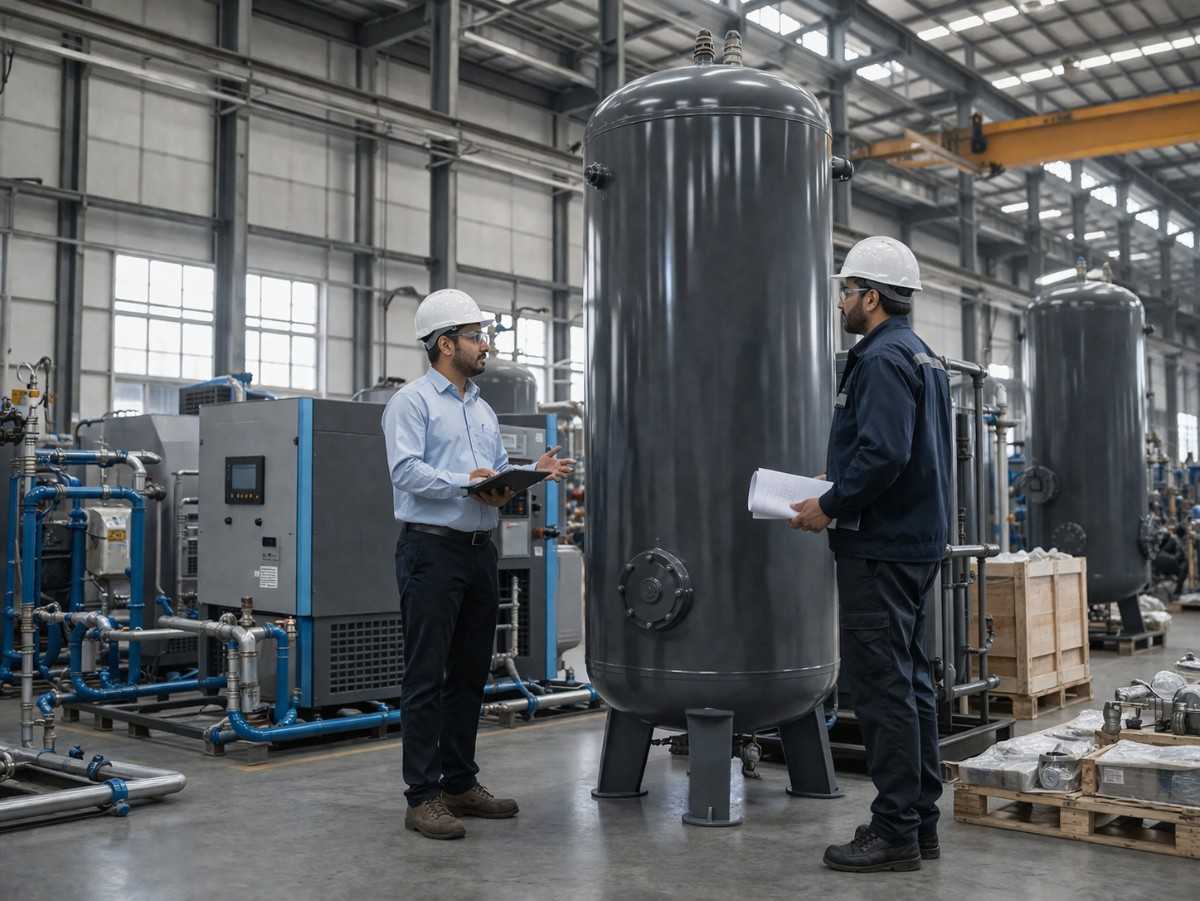
The Overlooked Hero of Your Compressed Air System
Walk into any manufacturing plant in India. An automotive factory in Pune. A pharmaceutical unit in Ahmedabad. A food processing plant in Kolkata.
What do you see everywhere?
Compressed air lines running across ceilings. Pneumatic tools on every workbench. Control valves hissing with energy.
But look closer. What is that large cylindrical tank sitting quietly next to the compressor?
That is the air receiver. And it is doing much more than just holding air.
Most plant managers and engineers focus all their attention on the air compressor. They research brands. Compare horsepower. Negotiate prices.
But they forget something critical.
The air receiver is not just a storage tank. It is the backbone of your entire compressed air system.
Without a properly designed, high quality air receiver, even the best compressor will underperform. Your pressure will fluctuate. Your tools will sputter. Your production will suffer.
And if you choose the wrong supplier? You could face leaks, safety violations, or even catastrophic failure.
This guide will help you find a reliable air receiver supplier in India. One who delivers quality, compliance, and peace of mind.
What Is an Air Receiver and Why Does Your Plant Need One?
Let us start with a clear definition.
An air receiver is a pressure vessel that stores compressed air from your compressor. It acts as a buffer between the compressor and your air tools or production equipment.
But calling it just a storage tank misses the point.
What an Air Receiver Actually Does
-
Stabilizes pressure fluctuations when your compressor cycles on and off
-
Stores a reserve of compressed air for peak demand periods
-
Cools the compressed air, allowing moisture to condense and drain out
-
Reduces how often your compressor starts and stops, extending its life
-
Provides a consistent air supply even when demand varies
Think of it like a water tank on a building rooftop. The pump fills the tank. Then gravity delivers steady water pressure to every tap. Without the tank, every time someone opened a tap, the pump would have to start instantly.
Same principle with air. The receiver tank smooths everything out.
The Cost of Operating Without a Proper Air Receiver
Plants that skip or undersize their air receiver face real problems.
-
Frequent pressure drops that stall production lines
-
Short cycling of the compressor, leading to premature wear
-
Higher electricity bills from inefficient compressor operation
-
Moisture in air lines that ruins paint jobs or clogs instruments
-
No backup air during compressor maintenance or breakdowns
Key Features to Look for in an Industrial Air Receiver
Before you start contacting suppliers, know what to ask for. Here are the critical specifications.
Material of Construction
The material determines durability, safety, and suitability for your application.
-
Mild Steel (MS): Most common, cost effective, suitable for general industrial use
-
Carbon Steel (CS): Stronger than MS, better for higher pressures
-
Stainless Steel (SS 304 / SS 316): Required for food, pharmaceutical, and chemical applications where corrosion resistance is critical
-
Special alloys (Titanium, Hastelloy): For highly corrosive or extreme environments
Pressure Rating
This is non negotiable for safety.
Your air receiver must be rated for at least the maximum pressure your compressor can deliver. Most industrial receivers are designed for 6 to 75 Kgf/cm² (approximately 85 to 1065 PSI).
Always ask for the design pressure. Never buy a receiver rated below your compressor output.
Volume Capacity
Size matters. Too small and you get pressure fluctuations. Too large and you waste money and floor space.
Common standard sizes available from Indian manufacturers:
-
0.5 m³
-
1 m³
-
2 m³
-
3 m³
-
4 m³
-
5 m³
-
Up to 90 m³ for large industrial applications
Higher capacities are available on request from most established manufacturers.
Compliance and Certification
This is where many suppliers cut corners. Do not let them.
Your air receiver must comply with recognized pressure vessel standards.
-
IS 2825: Indian standard for unfired pressure vessels
-
ASME Sec VIII Div 1: International standard, widely accepted globally
-
IBR (Indian Boiler Regulations): Required for certain applications in India
Ask for U Stamp certification if you need ASME compliance. This certification means the vessel has been inspected and approved by an authorised agency.
Essential Accessories
A bare tank is not enough. Your air receiver must come with or have fittings for:
-
Safety relief valve (mandatory for safety)
-
Pressure gauge to monitor tank pressure
-
Drain valve (manual or automatic) to remove condensed moisture
-
Inspection hole or manhole for internal cleaning and inspection
Top Industries That Rely on Air Receivers in India
Air receivers are not optional for these sectors. They are essential.
Manufacturing Plants
Automotive component makers. General engineering workshops. Plastic moulding units. Every pneumatic tool and automated machine needs stable air pressure. Fluctuations cause rejected parts and production delays.
Pharmaceutical Industry
Clean rooms and sensitive equipment require contamination free compressed air. Stainless steel receivers with polished interiors are standard here.
Food and Beverage Processing
Packaging lines. Bottling machines. Air knives for drying. The air must be clean and pressure must be consistent. Stainless steel receivers are mandatory for hygiene compliance.
Petrochemical and Chemical Plants
Process control systems. Instrumentation. Safety shutdown systems. These applications demand high pressure receivers built to rigorous standards.
Power Generation
Turbine control systems use compressed air for actuation. Any pressure fluctuation can affect power output. Large capacity receivers provide the necessary buffer.
Textile Industry
Air jet looms consume enormous volumes of compressed air. Without properly sized receivers, pressure drops cause thread breaks and fabric defects.
Construction and Mining
Portable compressor systems need rugged air receivers that can withstand rough handling and harsh environments.
How to Evaluate an Air Receiver Supplier in India
Not all suppliers are equal. Here is a checklist to separate the reliable ones from the rest.
Check Their Manufacturing Experience
Years in business matter. Fabricating pressure vessels is not simple welding. It requires engineering knowledge, proper equipment, and certified welders.
-
Look for suppliers with at least 10 to 15 years of experience
-
Established players like R&D Therm have been manufacturing since 1995
-
Veer Fabricators has been operating since 2004
Verify Their Certifications
Ask for documentation. A reliable supplier will share their certifications without hesitation.
-
ISO 9001 certification for quality management
-
ASME U Stamp certification for international compliance
-
Welder certifications from agencies like TUV, Lloyd's, or BV
Ask About Their Quality Control Process
How do they ensure every receiver meets specifications?
-
Material testing and certification
-
Weld inspection and non destructive testing (NDT)
-
Hydrostatic testing (filling with water under pressure to check for leaks)
-
Pneumatic testing with air
A supplier with a documented Quality Assurance Plan (QAP) is more reliable than one without.
Visit Their Facility or Ask for a Virtual Tour
If possible, see where your receiver will be built.
Look for:
-
Organized workshop with proper equipment
-
Welding robots for consistent quality on standard sizes
-
Separate quality control area
-
Proper material storage
R&D Therm, for example, uses Fanuc welding robots for receivers from 0.5m³ to 5m³, ensuring consistent weld quality.
Check Their Team Qualifications
Pressure vessel fabrication requires skilled people.
-
Certified welders with third party approvals
-
NDT Level II qualified inspectors
-
Experienced design engineers with licensed software
Ask About Their Standard Stock Sizes
Suppliers who keep standard sizes in stock are generally more established.
Common stock sizes available from good manufacturers:
-
0.5 m³
-
1 m³
-
2 m³
-
3 m³
-
4 m³
-
5 m³
If you need a non standard size, they should offer custom fabrication.
Common Mistakes Plant Managers Make When Buying Air Receivers
Learn from others. Avoid these costly errors.
Buying Only on Price
The cheapest air receiver will cost you more in the long run.
-
Thin walls that corrode faster
-
Poor welds that crack under pressure
-
No proper certification, risking legal trouble
-
Leaks that waste your compressed air energy
A pressure vessel failure is not just expensive. It is dangerous.
Ignoring the Drain Valve
Moisture accumulates inside the receiver. If you cannot drain it properly, your tank will rust from the inside. Eventually, it will fail.
Always install an automatic drain valve or ensure easy access for manual draining.
Forgetting About Future Expansion
Your plant will grow. Your air demand will increase. If you buy a receiver sized exactly for today, you will need to replace it next year.
Buy slightly larger than your current need. The upfront cost is small compared to buying a second tank later.
Overlooking Local Service and Support
What happens when your safety valve needs replacement? Or your pressure gauge fails?
A supplier in another state might take weeks to send spare parts. A local or regional supplier can respond faster.
Final Thoughts: Invest in Quality, Partner with Experts
Your compressed air system is only as strong as its weakest component.
The air receiver might not be the most glamorous part. But when it fails, your entire plant stops.
Finding a reliable air receiver supplier in India requires due diligence. Check their experience. Verify their certifications. Inspect their quality processes.
Do not rush. Do not compromise on safety.
A quality air receiver from a trusted supplier will serve your plant for 15 to 20 years or more. That is a long time to regret a bad decision.
Ready to upgrade or install a new compressed air system? Times Marketing can help you select the right compressor, receiver, dryer, and filtration for your specific application.
Contact our team for a complete compressed air system assessment.