
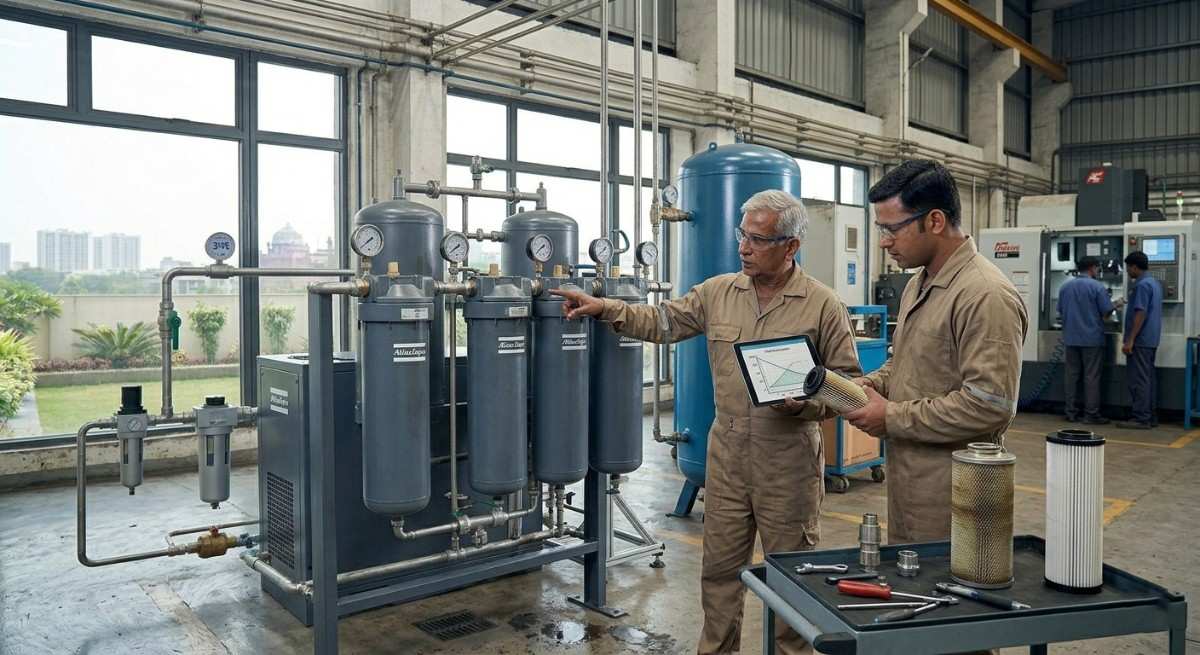
Most plant managers in India will tell you they change their coalescing air filter once a year.
Some will say they change it when the pressure drop gets noticeable.
A few will admit they cannot remember the last time it was changed at all.
Here is the uncomfortable truth. If you do not know exactly when your coalescing air filter was last serviced, your compressed air system is almost certainly not performing the way it should. And somewhere downstream, your equipment is paying the price.
Coalescing air filters are the frontline defence of your entire compressed air system. They remove oil aerosols, liquid water, and fine particulates from compressed air before it reaches your tools, machines, and production processes.
When the filter element is past its service life it stops doing its job. Contamination passes through freely. Equipment wears faster. Products get contaminated. And the whole point of having a filtration system in the first place is completely defeated.
This guide gives you the definitive answer on how often you should change your coalescing air filter and everything you need to know to manage your filtration maintenance correctly.
What a Coalescing Air Filter Actually Does
Before getting into replacement intervals it helps to understand exactly what a coalescing air filter does and why the filter element degrades over time.
Compressed air leaving your compressor contains oil aerosols, liquid water droplets, and fine solid particles even after passing through a basic particulate filter. These contaminants are extremely small, sometimes as tiny as 0.01 microns, and they travel at high velocity through your air distribution system.
A coalescing filter works by passing this contaminated air through a dense fibrous filter element. As the tiny oil and water droplets pass through the element fibres they collide and merge together into progressively larger droplets. This process is called coalescing.
Once the droplets are large enough they drain down the inside of the filter element under gravity and collect at the bottom of the filter bowl where they are removed by a drain valve.
The compressed air that exits the filter is significantly cleaner and drier than what entered. For most industrial applications this level of filtration is essential to protecting downstream equipment and maintaining product quality.
Over time the filter element becomes progressively loaded with the contaminants it has captured. As the element loads up its efficiency drops, pressure drop across the filter increases, and at some point contaminants begin to bypass the element and pass into your clean air system.
This is why regular filter element replacement is not optional maintenance. It is the only way to ensure your filtration system continues performing as intended.
The Standard Replacement Interval for Coalescing Air Filters
The most commonly recommended replacement interval for coalescing air filter elements across the industry is every 2000 operating hours or once every twelve months, whichever comes first.
This is the general guideline provided by most reputable filter manufacturers and it is a reasonable starting point for facilities operating in typical industrial conditions.
However the honest answer is that this single rule does not apply equally to every facility in India. Your actual replacement interval depends on several factors that are specific to your compressed air system and your operating environment.
Factors That Affect How Often You Need to Change Your Coalescing Air Filter
Compressor Oil Carryover
Every oil-lubricated compressor carries a small amount of oil into the compressed air it produces. The amount of oil carryover varies significantly between different compressor types, ages, and maintenance conditions.
A well-maintained modern screw compressor with good oil separators will produce much lower oil carryover than an older piston compressor with worn piston rings or a screw compressor with a degraded oil separator element.
Higher oil carryover means your coalescing filter element is working harder and loading up faster. In these conditions your replacement interval should be shorter than the standard twelve-month guideline.
Ambient Air Quality
The quality of the air your compressor draws in directly affects the contamination load on your entire filtration system.
A compressor operating in a clean, well-ventilated compressor room will produce compressed air with lower particulate loading than a compressor drawing in dusty air from a production floor or an outdoor environment.
Facilities in dusty industrial areas, near construction activity, or in locations with high atmospheric particulate levels will see their filter elements load up much faster. In these environments quarterly inspection and potentially more frequent replacement is advisable.
Humidity and Moisture Loading
India's climate creates significant challenges for compressed air filtration. High ambient humidity during monsoon season dramatically increases the moisture content of the air entering your compressor. This increased moisture loading places a higher demand on your coalescing filter element and accelerates its loading rate.
Facilities in high humidity coastal locations or those operating through extended monsoon seasons should inspect their coalescing filter elements more frequently during these periods and be prepared to replace them ahead of the standard twelve-month interval if pressure drop indicates early loading.
Operating Hours and Duty Cycle
A compressor running twenty-four hours a day seven days a week will push far more air through its coalescing filter than one running a single eight-hour shift. The 2000-hour guideline is based on operating hours not calendar time.
A facility running around the clock will reach 2000 operating hours in approximately three months. Waiting twelve months to change the filter in this situation means operating with a severely degraded filter element for nine months of the year.
Always track your compressor's actual operating hours and base your filter replacement on hours rather than calendar months if your system runs continuously or near continuously.
Downstream Application Sensitivity
The consequence of a degraded coalescing filter depends heavily on what the compressed air is used for.
In a pharmaceutical plant or food processing facility a filter element that is past its service life is a direct product quality and regulatory compliance risk. In these applications replacing filter elements conservatively and ahead of schedule is the right approach regardless of whether pressure drop has become noticeable.
In a general workshop environment serving pneumatic hand tools the consequences of a slightly degraded filter are less immediately critical, although equipment wear will still increase over time.
Match your replacement frequency to the sensitivity and criticality of your downstream application.
How to Know Your Coalescing Air Filter Needs Changing
Waiting for a visible sign of filter failure is not a good maintenance strategy. By the time a filter element shows obvious signs of degradation it has usually been underperforming for some time.
However there are practical indicators you should monitor regularly that tell you your filter element is approaching or has reached the end of its service life.
Pressure Drop Monitoring
Every coalescing filter has a specified initial pressure drop across the clean element and a maximum allowable pressure drop at end of service life. Most filter manufacturers recommend replacing the element when the pressure drop reaches 0.5 to 0.7 bar above the clean pressure drop.
Install pressure gauges on the inlet and outlet of your coalescing filter if they are not already fitted. The differential pressure reading gives you a direct indication of how loaded the filter element has become. When this differential reaches the replacement threshold change the element immediately.
Differential Pressure Indicators
Many modern coalescing filters are fitted with a visual differential pressure indicator, sometimes called a pop-up indicator or flag indicator. This device changes state visually when the pressure drop across the element reaches the replacement threshold.
Check this indicator during your regular rounds. When it signals a high pressure drop the element must be replaced without delay.
Increase in Downstream Moisture or Oil Contamination
If your downstream equipment, air tools, or pneumatic valves begin showing increased signs of oil or moisture contamination even though your air dryer is functioning correctly, a loaded or failed coalescing filter element is a likely cause.
Do not wait for equipment damage to confirm the diagnosis. If contamination levels increase unexpectedly inspect and replace the coalescing filter element as the first step in your investigation.
Scheduled Replacement Based on Operating Hours
The most reliable approach for any facility is to schedule coalescing filter element replacement based on actual compressor operating hours rather than waiting for a pressure drop indicator or contamination event to trigger action.
Set a maintenance reminder at 2000 operating hours or sooner if your operating conditions warrant it. Replace the element on schedule regardless of whether pressure drop has reached the maximum threshold. Proactive replacement is always cheaper than reactive repair.
Replacement Intervals by Application Type
Here is a practical guide to recommended coalescing air filter replacement intervals based on application type and operating conditions for Indian industrial facilities.
General Industrial Applications
For facilities running single shift operations in clean environments with well-maintained compressors, replacing the coalescing filter element annually or at 2000 operating hours is generally appropriate. Inspect the differential pressure indicator monthly.
Continuous Operations Running Multiple Shifts
For facilities running two or three shift operations, compressor operating hours accumulate rapidly. In these cases inspect the differential pressure indicator weekly and replace the filter element every three to four months or at 2000 operating hours whichever comes first.
High Humidity and Monsoon Season
During monsoon season when ambient humidity is at its highest, increase inspection frequency to weekly and be prepared to replace elements ahead of schedule if pressure drop rises faster than normal. Consider adding a pre-filter to reduce the moisture load on your coalescing element during the peak humidity months.
Pharmaceutical and Food Processing
In regulated industries replace coalescing filter elements every six months as a maximum interval regardless of pressure drop readings. Document all replacements as part of your compressed air quality management records for regulatory compliance purposes.
Dusty or Contaminated Environments
In environments with high atmospheric particulate levels or where the compressor draws in air from a dusty production floor, inspect filter elements monthly and replace them every three to six months depending on the rate of loading observed.
The Real Cost of Not Changing Your Coalescing Air Filter on Time
Some plant managers view filter element replacement as an unnecessary expense that can be deferred without consequence. The actual cost calculation tells a very different story.
A loaded coalescing filter element creates elevated pressure drop across your system. Your compressor must work harder to overcome this resistance and maintain operating pressure. This increased effort translates directly into higher electricity consumption every single hour the overloaded filter remains in service.
For an industrial compressor running continuously the additional energy cost of operating against a heavily loaded filter element can significantly exceed the cost of the replacement element itself within just a few weeks.
Beyond energy costs a degraded coalescing filter allows oil aerosols and moisture to pass through into your distribution system. This contamination damages pneumatic actuators, valves, and tools. It contaminates product in sensitive manufacturing processes. It accelerates corrosion inside your air receiver tank and distribution pipework.
The cumulative cost of this equipment damage and product contamination is many times greater than the cost of simply replacing the filter element on schedule.
Filter element replacement is not an expense. It is a cost-effective investment in the reliability and efficiency of your entire compressed air system.
Step by Step Guide to Replacing a Coalescing Air Filter Element
Replacing a coalescing filter element is a straightforward maintenance task that your team can complete quickly with the right procedure.
Step 1: Isolate the Filter From the System
Close the isolation valves on the inlet and outlet of the filter housing. Slowly open the manual drain or vent valve to release pressure from the filter housing before attempting to open it. Never open a pressurised filter housing.
Step 2: Remove the Filter Bowl
Unscrew the filter bowl from the housing using the correct tool. Some filter bowls can be removed by hand while others require a strap wrench. Take care as residual condensate may drain out when the bowl is removed.
Step 3: Remove the Used Filter Element
Lift or unscrew the used filter element from the filter head. Note the orientation and mounting method before removal so the new element is installed correctly. Inspect the used element for any unusual contamination that might indicate an upstream system issue.
Step 4: Clean the Filter Bowl
Wipe the inside of the filter bowl with a clean dry cloth to remove any residual oil or contamination. Check the bowl O-ring or seal for any signs of damage or deterioration and replace it if needed to ensure a leak-free seal after reassembly.
Step 5: Install the New Filter Element
Install the new genuine replacement filter element following the manufacturer's instructions. Ensure it is correctly seated and secured. Using genuine replacement elements is critical. Non-genuine elements may not seal correctly in the housing or may have incorrect filtration specifications.
Step 6: Reassemble and Pressurise
Refit the filter bowl and tighten to the manufacturer's specified torque. Close the vent valve and slowly open the inlet isolation valve to pressurise the filter. Check all joints for air leaks using soapy water before fully opening the outlet isolation valve and returning the filter to service.
Step 7: Reset the Differential Pressure Indicator
If your filter is fitted with a differential pressure indicator reset it after installing the new element so it accurately monitors the condition of the fresh element going forward.
Step 8: Record the Replacement
Log the date, operating hours, and details of the filter element replacement in your maintenance records. For regulated industries this documentation forms part of your compressed air quality management system.
Frequently Asked Questions About Coalescing Air Filter Replacement
Q1. Can I clean and reuse a coalescing filter element instead of replacing it?
No. Coalescing filter elements are designed for single use and cannot be cleaned and reused effectively. The coalescing fibres in the element become permanently contaminated with oil and particulates during use. Attempting to clean the element does not restore its filtration performance and risks damaging the delicate fibre structure. Always replace with a new genuine element.
Q2. What happens if I use a non-genuine replacement filter element?
Non-genuine filter elements may appear similar to genuine elements but they often have different fibre density, incorrect micron ratings, or inferior sealing surfaces. Using a non-genuine element can result in inadequate filtration allowing contamination to pass through, incorrect pressure drop characteristics, poor sealing in the filter housing, and potential collapse of the element under operating pressure. Always use genuine replacement elements from the original manufacturer or a certified supplier.
Q3. My differential pressure indicator has not triggered yet but the filter has been in service for over a year. Should I still change it?
Yes. Time in service is an important factor alongside pressure drop. Even if the differential pressure indicator has not triggered, a filter element that has been in service for twelve months or more in typical industrial conditions should be replaced on schedule. The indicator triggers based on pressure drop only and does not measure element degradation from biological growth, chemical contamination, or structural fatigue that can occur independently of pressure drop.
Q4. Should I change the coalescing filter element and the particulate pre-filter at the same time?
It is good practice to inspect both elements at the same service interval. If both are due for replacement at similar times replacing them together reduces the number of system shutdowns required and ensures both stages of your filtration system are performing correctly after the service. In some systems the pre-filter element has a shorter service life than the coalescing element and may need more frequent replacement.
Q5. How do I know if my coalescing filter is the right specification for my compressor?
Your coalescing filter should be rated for a flow capacity that matches or exceeds your compressor's free air delivery. It should also be rated for your system operating pressure and the inlet air temperature. The filtration efficiency should be appropriate for your application. A qualified compressed air filtration specialist can confirm whether your current filter specification is correct and recommend upgrades if needed.
Q6. Does installing an air dryer reduce the frequency at which I need to change my coalescing filter?
Yes. A refrigerated or desiccant air dryer installed upstream of your coalescing filter reduces the moisture loading on the filter element significantly. With less liquid water entering the filter the element loads up more slowly and may reach its pressure drop limit less quickly. However the time-based replacement interval of twelve months still applies regardless of moisture loading because other forms of filter degradation occur independently of moisture.
Why Times Marketing Is Your Trusted Partner for Compressed Air Filtration in India
At Times Marketing we supply a comprehensive range of coalescing air filters and genuine replacement elements for every major filter brand and specification used in Indian industry.
Our technical team can assess your existing filtration system, confirm whether your current specification is adequate for your application and compressor output, and recommend the correct replacement intervals based on your specific operating conditions.
We also supply complete compressed air treatment systems including pre-filters, coalescing filters, activated carbon filters, refrigerated air dryers, desiccant air dryers, and automatic drain valves so you can build or upgrade your entire air treatment system through a single trusted partner.
Our service team supports customers across India with genuine spare parts, filter element supply, and technical guidance that keeps compressed air systems performing reliably year after year.
Conclusion
The answer to how often you should change your coalescing air filter is not simply once a year and forget about it.
The right interval depends on your compressor operating hours, your ambient conditions, your downstream application sensitivity, and the actual pressure drop readings across your filter. For most Indian industrial facilities operating in normal conditions the guideline of every 2000 operating hours or twelve months is a sound starting point.
But the most important thing is to have a clear, documented replacement schedule and to stick to it consistently. Proactive filter maintenance is one of the simplest and most cost-effective things you can do to protect your compressed air system, reduce energy waste, and prevent expensive equipment damage.
Times Marketing is here to help you get your compressed air filtration right. Contact our team today for expert advice on the correct coalescing filter specification, replacement intervals, and genuine filter elements for your specific system.