
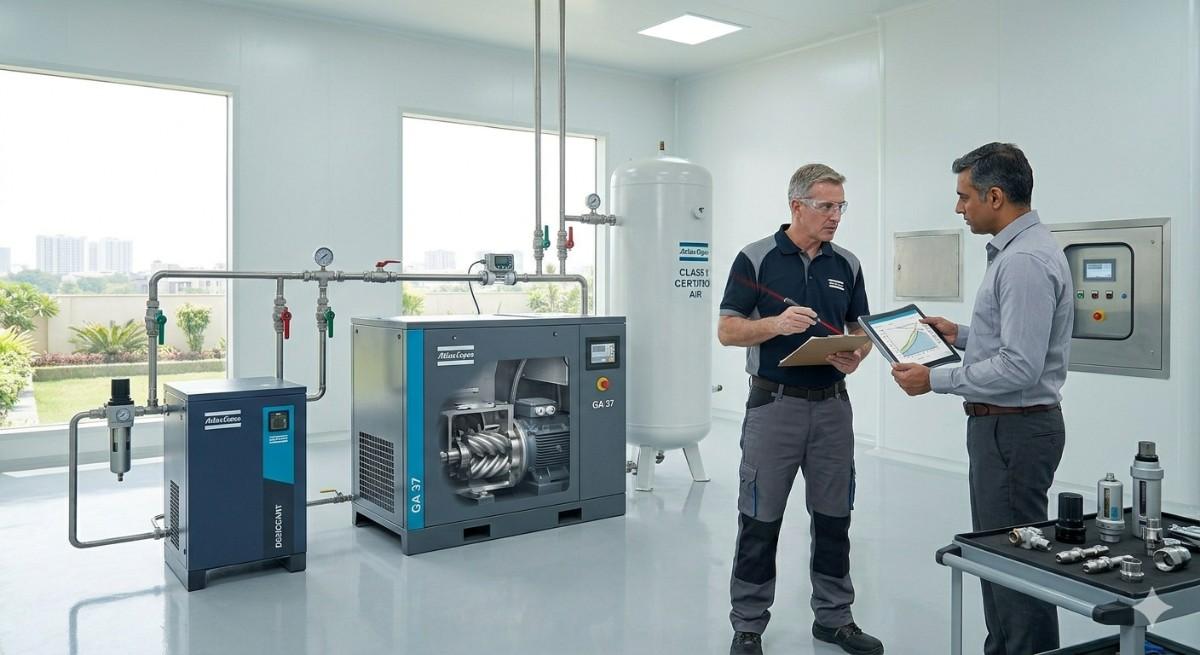
You are ready to invest in a new air compressor for your facility. You open a catalogue, and suddenly you are staring at dozens of models, different types, different capacities, different pressure ratings, different price points.
Where do you even begin?
This is one of the most common challenges factory managers, procurement teams, and business owners face. Buying the wrong industrial air compressor is an expensive mistake. Too small, and it struggles to keep up with demand. Too large, and you are wasting energy every single day. Wrong type, and your product quality or process safety could be compromised.
The good news is that choosing the right industrial air compressor does not have to be complicated. With the right guidance, it becomes a clear, logical process.
In this guide, we will walk you through everything you need to consider, step by step. By the end, you will know exactly what to look for and how to make a confident decision for your facility.
What Is an Industrial Air Compressor?
An industrial air compressor is a machine that takes in ambient air and compresses it to a higher pressure, which is then used to power tools, drive automation, control processes, and support production across a manufacturing facility.
Unlike small, portable compressors used for occasional tasks, industrial air compressors are built for:
- High-volume, continuous air output
- Heavy-duty, long-hour operation
- Reliable performance in demanding industrial environments
- Integration with filtration, drying, and distribution systems
The most common types of industrial air compressors used in factories today are:
- Rotary screw compressors: Best for continuous, heavy-duty use. Most popular choice for manufacturing plants.
- Reciprocating (piston) compressors: Suitable for intermittent use and lighter applications.
- Centrifugal compressors: Used in very large-scale operations requiring massive air volumes.
- Oil-free compressors: Required where air quality is critical, such as in food, pharma, and electronics.
Understanding the differences between these types is the first step toward choosing the right industrial air compressor for your needs.
Why Choosing the Right Industrial Air Compressor Matters
Many businesses treat the compressor purchase as a box-ticking exercise. They pick the cheapest option or simply replace like for like without assessing whether their needs have changed.
This approach almost always costs more in the long run.
Here is why getting the choice right from the start matters so much:
Impact on Production Efficiency
An undersized industrial air compressor cannot keep up with peak demand. Pressure drops. Tools underperform. Production slows. In contrast, a correctly sized compressor delivers consistent pressure and volume, keeping your entire operation running smoothly.
Impact on Energy Costs
Compressed air systems account for 20 to 30% of total electricity consumption in many factories. Choosing an energy-efficient industrial air compressor, especially one with variable speed drive technology, can reduce your energy bill significantly every month.
Impact on Product Quality
Inconsistent air pressure or contaminated compressed air leads to product defects. Paint finishes become uneven. Filling machines become inaccurate. Pharmaceutical processes get compromised. The right compressor with the right air treatment system protects your product quality consistently.
Impact on Maintenance Costs
A well-matched industrial air compressor runs within its design parameters, experiences less mechanical stress, and requires less frequent servicing. A mismatched unit works harder than it should, wears out faster, and costs more to maintain.
Impact on Safety
In sensitive industries like food production, pharmaceuticals, and electronics, using the wrong type of compressor (oil-injected instead of oil-free, for example) can create serious contamination and safety risks.
Clearly, the decision deserves careful thought.
How to Choose the Right Industrial Air Compressor: Step-by-Step Guide
Here is a practical, step-by-step framework that will help you make the right decision with confidence:
Step 1: Calculate Your Total Air Demand
Start by listing every piece of equipment in your facility that uses compressed air. For each item, note its air consumption in CFM (cubic feet per minute) or liters per minute.
Add up the total consumption of all equipment that may run simultaneously during peak operation. Then add a safety buffer of 20 to 25% to account for future expansion, air leaks in the piping system, and simultaneous start-up loads.
This gives you the minimum free air delivery (FAD) your industrial air compressor must provide.
Real-life example: A mid-size automotive components factory has 12 pneumatic tools, 3 robotic arms, and a spray painting booth running simultaneously. Their peak demand adds up to 280 CFM. With a 25% buffer, they need an industrial air compressor capable of delivering at least 350 CFM.
Step 2: Determine Your Required Working Pressure
Identify the highest working pressure required by any piece of equipment in your facility. This is measured in bar or PSI.
Most industrial applications operate between 7 and 10 bar. However, some processes like sandblasting or high-pressure testing may require more.
Your industrial air compressor must be able to deliver your required pressure consistently at full load. Do not choose a compressor that only just meets your pressure requirement. Always leave a reasonable margin.
Step 3: Choose the Right Compressor Type
Once you know your air demand and pressure requirement, the next step is selecting the right type of industrial air compressor.
For most factories running operations for 8 hours or more per day, a rotary screw compressor is the clear choice. It is built for continuous duty, delivers consistent airflow, and is highly energy efficient.
For workshops or facilities with intermittent air demand (running tools for short periods with rest in between), a reciprocating piston compressor may be a cost-effective option.
For very large-scale operations requiring massive air volumes at moderate pressure, centrifugal compressors offer an efficient solution.
Step 4: Decide Between Oil-Injected and Oil-Free
This is a critical decision that depends entirely on your application:
- Oil-injected industrial air compressor: Uses oil for lubrication, cooling, and sealing. Delivers Class 1 to Class 3 air quality (with proper filtration). Suitable for automotive, metalworking, textile, construction, and general manufacturing.
- Oil-free industrial air compressor: Delivers 100% oil-free compressed air (Class Zero). Essential for food and beverage, pharmaceutical, semiconductor, and medical device manufacturing where air purity is non-negotiable.
Using an oil-injected compressor in a food or pharma application, even with filtration, carries risks that no responsible manufacturer should take. If in doubt, always choose oil-free.
Step 5: Fixed Speed or Variable Speed Drive?
This decision has a significant impact on your energy costs.
- Fixed-speed industrial air compressor: Runs at a constant speed regardless of air demand. Best suited for operations with consistent, steady air consumption throughout the day.
- Variable speed drive (VSD) industrial air compressor: Automatically adjusts motor speed to match actual air demand. Best for operations where air demand fluctuates throughout shifts.
If your factory's air demand varies by more than 20 to 30% during the day, a VSD industrial air compressor will deliver meaningful energy savings, often reducing compressor energy consumption by 25 to 35%.
Step 6: Plan Your Air Treatment System
Compressed air leaving the compressor is hot, saturated with moisture, and may contain oil particles and contaminants. Before it reaches your production equipment, it must be treated.
A complete air treatment system typically includes:
- Refrigerated air dryer: Removes moisture to prevent corrosion in pipes and damage to pneumatic equipment.
- Desiccant air dryer: For applications requiring very low dew points, such as pharmaceutical or instrument air.
- Coalescing filters: Remove oil aerosols and fine particles.
- Activated carbon filters: For oil-free air applications requiring the highest purity levels.
- Oil-water separator: For environmentally responsible disposal of condensate.
Never budget for the compressor alone. Plan for the complete compressed air system.
Step 7: Consider Installation and Space Requirements
Before finalising your purchase, assess the physical requirements:
- Does the installation space have adequate ventilation for heat dissipation?
- Is the electrical supply sufficient for the compressor's power requirement?
- Is the floor strong enough to support the compressor's weight?
- Is there enough space for maintenance access around the unit?
A compact, integrated industrial air compressor unit with a built-in dryer and controller can save significant floor space compared to separately installed components.
Step 8: Evaluate Total Cost of Ownership
Never choose an industrial air compressor based on purchase price alone. The true cost of ownership over the compressor's lifespan includes:
- Purchase price
- Installation and commissioning costs
- Energy consumption (the largest ongoing cost)
- Maintenance and spare parts costs
- Downtime costs in case of breakdown
- Expected operational lifespan
A premium industrial air compressor may cost 20 to 30% more upfront but deliver significantly lower energy and maintenance costs over 10 to 15 years, making it the far more economical choice in the long run.
Common Mistakes to Avoid When Choosing an Industrial Air Compressor
Even experienced buyers make these errors. Here is what to watch out for:
Mistake 1: Undersizing the Compressor
Buying a compressor that barely meets current demand leaves no room for growth or air leaks. Always build in a capacity buffer.
Mistake 2: Ignoring Air Quality Requirements
Using an oil-injected compressor in a food or pharma environment because it is cheaper is a serious mistake. Always match the compressor type to your air quality requirements.
Mistake 3: Overlooking Energy Efficiency
Choosing a cheap, inefficient compressor to save money upfront often results in significantly higher energy bills for years. Calculate the total cost of ownership, not just the sticker price.
Mistake 4: Neglecting Air Treatment
A compressor without proper drying and filtration delivers wet, contaminated air that damages equipment and ruins product quality. Budget for the full system.
Mistake 5: Choosing a Supplier Without After-Sales Support
An industrial air compressor requires regular servicing and occasional repairs. Choosing a supplier who disappears after the sale leaves you without support when you need it most.
Why Choose Times Marketing for Your Industrial Air Compressor?
With so many suppliers in the market, what makes Times Marketing the right partner for your compressed air needs?
Here is the honest answer:
- Application-First Approach: Times Marketing starts by understanding your facility, your processes, and your air demand before recommending any product. You get a solution tailored to your actual needs, not a generic catalogue recommendation.
- Complete Range: Whether you need a small 5 kW workshop compressor or a large 200 kW industrial air compressor for a heavy manufacturing plant, Times Marketing covers every scale and every industry.
- System Design Expertise: Their team designs complete compressed air systems including piping, air treatment, and controls, not just the compressor itself.
- Energy Audits: Times Marketing offers compressed air energy audits that identify leaks, inefficiencies, and upgrade opportunities in your existing system, helping you reduce costs before you even buy a new compressor.
- Genuine Parts and Qualified Service: All maintenance is carried out using original spare parts by trained technicians, ensuring your industrial air compressor performs as designed throughout its life.
- Transparent Advice: Times Marketing gives you honest guidance, even if that means recommending a smaller or less expensive unit than you originally thought you needed.
Choosing Times Marketing means choosing a partner who is invested in the long-term performance of your compressed air system.
Frequently Asked Questions (FAQs)
Q1. How do I know what size industrial air compressor I need? Calculate the total CFM or liters per minute required by all your compressed air equipment running simultaneously at peak demand. Add a 20 to 25% buffer. This gives you the minimum free air delivery your compressor must provide. Times Marketing can conduct a free site assessment to help you get this right.
Q2. Is a rotary screw compressor always better than a piston compressor? For continuous, heavy-duty factory use, yes. A rotary screw industrial air compressor is designed for 100% duty cycle operation, delivers smoother airflow, and is more energy efficient for long-hour use. A piston compressor is more suitable for intermittent, lighter applications.
Q3. Do I really need an oil-free industrial air compressor? Only if your application requires it. Food, beverage, pharmaceutical, semiconductor, and medical device manufacturing typically require oil-free compressed air. For general manufacturing, metalworking, and automotive applications, a high-quality oil-injected compressor with proper filtration is perfectly acceptable.
Q4. How much does an industrial air compressor cost to run? Energy is the biggest running cost. A 37 kW industrial air compressor running 8 hours a day, 250 days a year, consumes roughly 74,000 kWh of electricity annually. At an average industrial electricity rate, that represents a significant expense. Choosing an energy-efficient or variable speed drive model can reduce this substantially.
Q5. How often does an industrial air compressor need servicing? Most industrial air compressors require a basic service every 2,000 operating hours and a comprehensive service every 4,000 hours. Always follow the manufacturer's recommended maintenance schedule and use genuine spare parts to protect your warranty and equipment life.
Conclusion
Choosing the right industrial air compressor is one of the most important infrastructure decisions you will make for your facility. Get it right, and you gain a reliable, efficient compressed air system that supports your operations for 10 to 15 years. Get it wrong, and you face years of high energy bills, frequent breakdowns, and production headaches.
The key is to take a systematic approach: understand your air demand, match the compressor type to your application, plan for air treatment, and choose a supplier who supports you beyond the sale.
If you are ready to make the right choice for your facility, Times Marketing is here to help. Their team of compressed air specialists will guide you through every step, from initial assessment to installation and ongoing maintenance.
Contact Times Marketing today for a free consultation and site assessment. Let their experts help you find the perfect industrial air compressor for your business and build a compressed air system that delivers reliable performance for years to come.
Get in touch with Times Marketing and take the first step toward a smarter, more efficient factory.