
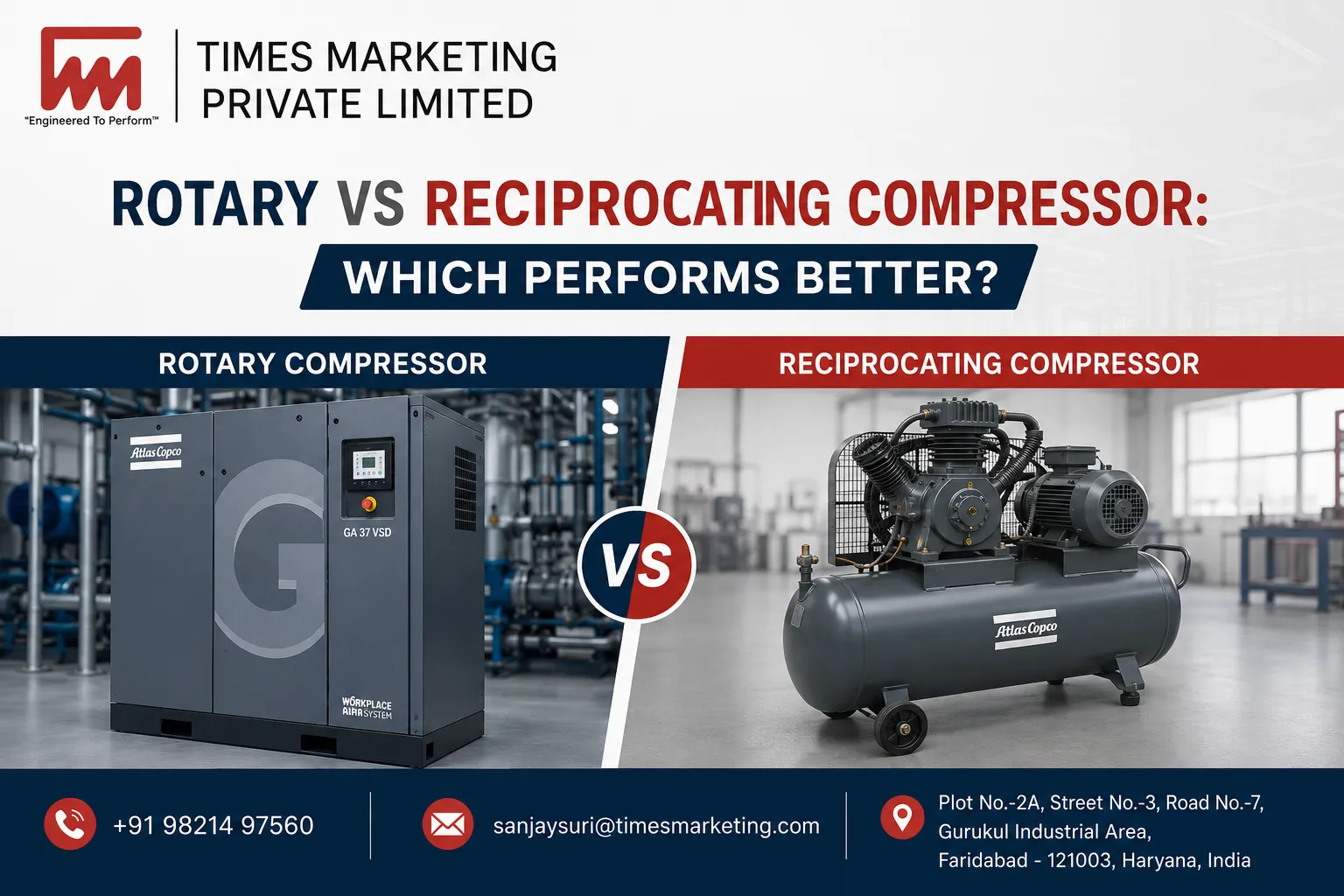
That said, performance is a fair thing to interrogate, and this guide does exactly that. We will look at rotary vs reciprocating compressor performance across the metrics that actually matter on a factory floor: output consistency, energy efficiency, noise, maintenance demand, and suitability for different duty cycles. By the end, you will have a clear framework for deciding which machine performs better for your specific plant, rather than a generic answer that may not apply to your situation at all.
Two Different Machines, Two Different Performance Profiles
A reciprocating air compressor compresses air using a piston that moves up and down inside a cylinder, drawing air in on the downstroke and forcing it out on the upstroke. This produces air in pulses, one burst per stroke, which is why reciprocating machines are historically associated with a distinctive rhythmic sound and slightly uneven downstream pressure unless buffered by an air receiver.
A rotary compressor, most commonly encountered in industrial settings as a rotary screw air compressor, uses two meshing helical rotors that continuously trap and compress air as they turn. There is no stroke, no pulse, just a steady, uninterrupted flow of compressed air from intake to discharge.
This mechanical distinction is the foundation of every performance difference between the two, so it is worth keeping in mind as we go through each comparison below.
Performance Metric 1: Output Consistency
Short Answer: Rotary compressors deliver smoother, more consistent air output than reciprocating compressors, which is critical for processes sensitive to pressure fluctuation.
Because a reciprocating machine compresses air in individual strokes, the discharge pressure naturally pulses unless smoothed out by a properly sized air receiver. For applications like pneumatic tools or basic workshop tasks, this is rarely noticeable. But for automated production lines, precision instrumentation, or processes where consistent pressure directly affects product quality, that pulsation can become a real operational issue.
Rotary compressors, by contrast, produce a continuous flow with minimal pressure variation, which is why they are the standard choice for automated manufacturing environments where consistency matters as much as raw capacity.
Performance Metric 2: Energy Efficiency Under Continuous Load
Quick Facts
- Reciprocating compressors manage variable demand primarily through load and unload cycling, which can waste energy during frequent starts and stops
- Rotary screw compressors, especially those with VSD (Variable Speed Drive) technology, adjust motor speed to match real time demand
- Continuous industrial operation generally favors rotary technology from an energy efficiency standpoint
- Intermittent, low volume use often does not generate enough runtime for the efficiency gap to matter significantly
For a plant running compressed air demand across multiple shifts, this efficiency difference compounds daily and becomes one of the largest ongoing operating costs associated with either machine. A rotary compressor sized correctly for continuous duty, particularly with VSD, typically consumes less electricity per unit of air delivered than a reciprocating compressor pushed into the same continuous role.
Performance Metric 3: Noise and Vibration
Reciprocating compressors generate more mechanical noise and vibration due to the piston's back and forth motion, which can be a genuine consideration in facilities where the compressor room sits close to work areas or offices. Rotary compressors run considerably quieter thanks to their smooth rotational motion, making them the more practical choice for noise sensitive environments.
Did You Know? In many Indian manufacturing facilities, compressor room placement is often decided based on available space rather than noise impact, which sometimes results in reciprocating units being installed closer to work areas than ideal. If noise is a concern in your facility, this is worth factoring into the technology decision itself, not just the installation location.
Performance Metric 4: Duty Cycle Suitability
This is where the "which performs better" question really depends on context. Reciprocating compressors are engineered for intermittent duty, meaning they are designed to run, rest, and run again, not operate continuously for extended periods. Rotary compressors are built for continuous duty and are far more tolerant of round the clock operation.
| Duty Cycle Pattern | Better Performing Technology |
|---|---|
| Occasional, short bursts of air use | Reciprocating compressor |
| Single shift, moderate continuous use | Either, depending on capacity needs |
| Multi shift, continuous production | Rotary screw compressor |
| Fluctuating demand across the day | Rotary compressor with VSD |
Warning: Running a reciprocating compressor continuously beyond its intended duty cycle is one of the most common causes of premature valve and ring failure we encounter during service visits. If your plant's air demand has grown into continuous territory, that is usually the clearest signal it is time to evaluate a rotary alternative.
Performance Metric 5: Maintenance Demand and Downtime Risk
Reciprocating compressors have more moving parts subject to friction and wear, including piston rings, valves, and cylinder walls, which require more frequent inspection and replacement. Rotary compressors have fewer high wear components in continuous contact, which generally translates to longer service intervals when the machine is matched correctly to its duty cycle.
| Maintenance Factor | Reciprocating Compressor | Rotary Screw Compressor |
|---|---|---|
| Wear Component Frequency | Higher, piston rings and valves | Lower, primarily airend and bearings |
| Service Interval | Shorter | Longer, per manufacturer running hours |
| Downtime Risk Under Continuous Use | Higher | Lower when correctly sized |
| Skill Level Required for Service | Generally simpler | Requires trained technical support |
A Site Assessment Story Worth Sharing
A production manager at a components manufacturing unit once reached out after his facility had gone through three reciprocating compressors in five years, each one wearing out faster than expected. On inspection, the pattern was clear: the plant's air demand had grown steadily as automation increased, and the reciprocating machines were being run nearly around the clock to keep pace, well beyond what they were designed for.
The fix was not a better reciprocating compressor. It was switching to a correctly sized rotary screw system suited for continuous operation. Within the first year, unplanned downtime related to the compressor dropped noticeably, and the maintenance team stopped budgeting for frequent valve replacements. This is a pattern worth recognizing early: if your air demand has outgrown intermittent use, no amount of reciprocating compressor upgrades will fully solve a duty cycle mismatch.
Technical Fundamentals That Apply to Both Technologies
Regardless of which machine you choose, a few core concepts determine whether it will actually perform well in your facility.
FAD (Free Air Delivery) is the real usable air output at standard atmospheric conditions, and it matters more than motor horsepower when comparing machines of either technology.
Working Pressure (PSI or Bar) needs to align with your connected equipment. Oversizing pressure wastes energy regardless of compressor type.
Air Quality. Both rotary and reciprocating compressors are available in oil lubricated and oil free configurations. Industries with strict contamination requirements, such as pharmaceuticals or food processing, should evaluate air quality needs independently of the compression technology decision.
Air Dryers and Filters protect downstream equipment from moisture and particulates regardless of which compressor generates the air, and should always be evaluated as part of the full compressed air system rather than an afterthought.
Air Receivers help buffer pressure fluctuations, which is particularly useful for smoothing out the pulsating output of a reciprocating compressor.
Decision Tree: Choosing Based on Performance Needs
Step 1: Is your air demand continuous across shifts, or occasional and intermittent?
- Continuous → lean toward rotary
- Intermittent → reciprocating may be sufficient
Step 2: Does your process require stable, pulsation free pressure?
- Yes → rotary is the stronger performer
- No, minor fluctuation is acceptable → either can work with a properly sized air receiver
Step 3: Is noise a factor in your facility layout?
- Yes → rotary generally performs better
- Not a major concern → either is viable
Step 4: What is your budget tolerance for upfront investment versus long term operating cost?
- Lower upfront priority → reciprocating for smaller capacity needs
- Long term efficiency priority → rotary, particularly with VSD
Step 5: Do you have in house technical capability for more involved maintenance, or do you need simpler upkeep?
- Simpler upkeep preferred → reciprocating for smaller applications
- Trained technical support available → rotary systems perform well with structured preventive maintenance
Common Mistakes in the Rotary vs Reciprocating Decision
Mistake 1: Choosing Based on What the Plant Already Owns. Sticking with reciprocating compressors simply because that is the existing setup, even as demand has grown into continuous territory, leads to recurring breakdowns.
Mistake 2: Ignoring Total Lifecycle Cost. Comparing only the purchase price without factoring in energy consumption and maintenance frequency over the machine's operating life skews the decision.
Mistake 3: Over Specifying a Rotary System for Minimal, Occasional Use. For very small, intermittent air demand, a rotary compressor can be an unnecessarily large investment.
Mistake 4: Underestimating Noise Impact During Installation Planning. Placing a reciprocating compressor near work areas without considering its higher noise output creates avoidable workplace friction.
Mistake 5: Skipping a Proper Site Assessment. Ambient temperature, altitude, and actual duty cycle all affect which technology will genuinely perform better in your specific facility.
Maintenance Best Practices for Long Term Performance
| Task | Frequency | Applies To |
|---|---|---|
| Visual and audio inspection | Every shift | Both technologies |
| Valve and piston ring check | Regular | Reciprocating compressors |
| Airend and rotor inspection | Per running hours | Rotary compressors |
| Filter inspection | Monthly | Both technologies |
| Leak testing across piping | Periodic | Both technologies |
| Full technical service | Per manufacturer schedule | Both technologies |
Expert Tip: Track pressure drop across your filters and dryers over time, regardless of which compressor technology you use. A steady increase is often the earliest sign of a component nearing the end of its service life.
Where Atlas Copco Fits Into This Decision
Atlas Copco compressors span both reciprocating and rotary screw technology, which means the manufacturer question does not have to be separate from the technology question. As an authorized supplier of Atlas Copco India equipment, Times Marketing can evaluate your actual duty cycle and air demand, then recommend whichever technology genuinely performs better for your application, rather than defaulting to one product line regardless of fit. Sometimes that means a compact reciprocating unit for a low volume workshop, and sometimes it means a full rotary screw system with VSD for a continuous production environment.
Conclusion
There is no universal winner in the rotary vs reciprocating compressor debate, only a better fit for your specific plant's duty cycle, air quality needs, and production demands. Rotary compressors generally outperform on continuous output consistency, energy efficiency at sustained loads, and noise, while reciprocating compressors remain a practical, cost effective performer for smaller, intermittent applications. The real performance question is not which machine is objectively better, but which one is being asked to do the job it was actually engineered for.
Call to Action
If you are trying to determine whether a rotary or reciprocating compressor will genuinely perform better for your facility, Times Marketing can help you answer that with a proper technical assessment rather than guesswork. Our team can evaluate your actual duty cycle and air demand, recommend the right solution including genuine Atlas Copco compressors, and support you through installation and ongoing maintenance. Contact Times Marketing to schedule a consultation, request a tailored product recommendation, or arrange a site assessment for your plant.