
There are problems in industrial compressed air systems that a refrigerated air dryer simply cannot solve.
A pharmaceutical plant in Hyderabad needs compressed air with a pressure dew point of minus 40 degrees Celsius to meet regulatory air purity standards. A precision instrument manufacturer in Pune cannot afford even trace amounts of moisture in their instrument air lines. An electronics assembly facility in Bengaluru requires ultra-dry air throughout every production shift to protect sensitive circuit boards from moisture-related failures.
For all of these applications and many more across Indian industry, a desiccant air dryer is not optional. It is the only solution that delivers the level of air dryness these processes genuinely require.
If you have heard the term desiccant air dryer and wondered what it means, how it works, and whether your facility needs one, this guide covers everything clearly and practically from start to finish.
The Problem That Desiccant Air Dryers Are Built to Solve
To understand why desiccant air dryers exist you first need to understand the limitations of conventional air drying methods.
A refrigerated air dryer works by cooling compressed air to around 3 degrees Celsius and condensing moisture out of the airstream. For most general industrial applications this is perfectly adequate. The resulting pressure dew point of 3 to 7 degrees Celsius keeps liquid water out of your distribution system and protects your pneumatic equipment reliably.
But some applications demand far more than this.
When compressed air is used in pharmaceutical manufacturing, medical gas systems, food contact applications, electronics production, or critical instrumentation the moisture content must be reduced to levels that a refrigerated dryer simply cannot achieve.
At very low temperatures or in applications where even microscopic amounts of moisture cause damage, a pressure dew point of minus 20, minus 40, or even minus 70 degrees Celsius is required.
This is the problem that a desiccant air dryer is specifically engineered to solve. It removes moisture from compressed air to levels that are far beyond the capability of any refrigeration-based system.
What Is a Desiccant Air Dryer
A desiccant air dryer is a compressed air treatment device that uses a hygroscopic material called a desiccant to adsorb water vapour directly from compressed air as it passes through the dryer vessel.
Unlike a refrigerated dryer which works by cooling air to condense moisture, a desiccant dryer works through a chemical process called adsorption. The desiccant material attracts water vapour molecules and holds them on its surface as the compressed air flows through, producing extremely dry air at the outlet.
The desiccant material used in industrial dryers is most commonly activated alumina or silica gel. Both materials are highly porous with enormous internal surface areas that allow them to adsorb large quantities of moisture relative to their physical size.
Desiccant air dryers are capable of achieving pressure dew points as low as minus 40 to minus 70 degrees Celsius in standard industrial configurations. This level of dryness makes them the correct and often only viable choice for the most moisture-sensitive applications in Indian industry.
How a Desiccant Air Dryer Actually Works
The working principle of a desiccant air dryer is elegant in its simplicity once you understand the basic concept. Here is a clear step-by-step explanation of the process.
The Twin Tower Design
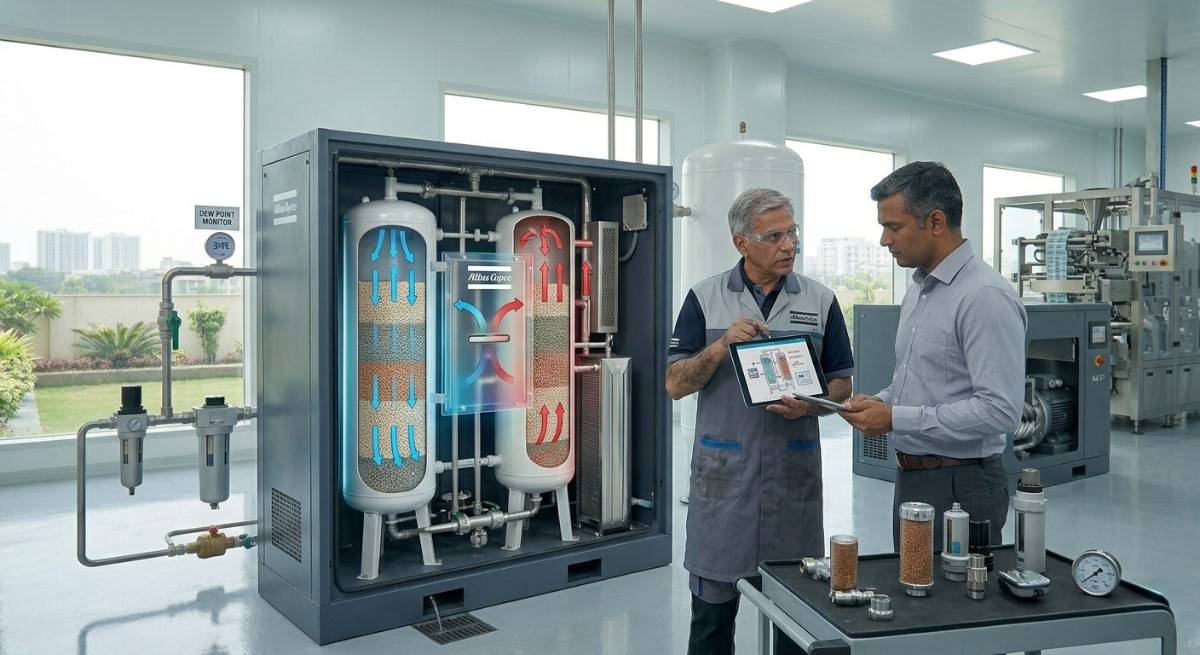
Almost all industrial desiccant air dryers use a twin tower configuration. The dryer contains two vessels or towers each filled with desiccant material. While one tower is actively drying the compressed air the other tower is being regenerated so that its desiccant material is dried out and ready for the next drying cycle.
This alternating operation allows the dryer to deliver a continuous supply of dry compressed air without interruption.
The Drying Phase
Wet compressed air from your system enters the active drying tower and flows through the bed of desiccant material. As the air passes through, water vapour molecules are adsorbed onto the surface of the desiccant granules. The now-dry compressed air exits the top of the tower and passes into your distribution system.
The drying cycle continues until the desiccant bed becomes saturated with moisture and can no longer effectively adsorb additional water vapour. At this point the system automatically switches the airflow to the regenerated tower and begins the regeneration process on the saturated tower.
The Regeneration Phase
Regeneration is the process of driving the accumulated moisture out of the saturated desiccant so it can be used again for drying. This is what distinguishes the different types of desiccant air dryers from one another and significantly affects their operating costs and energy consumption.
In a heatless desiccant dryer a small portion of the already-dried compressed air is expanded to atmospheric pressure and passed back through the saturated desiccant bed. This dry purge air picks up the moisture from the desiccant and carries it out through the exhaust. The regeneration process consumes around 15 to 20 percent of the dryer's compressed air output which represents a real operating cost.
In a heated desiccant dryer external heat is applied to assist the regeneration process. This reduces the amount of purge air required and significantly improves the overall energy efficiency of the dryer compared to a heatless model.
In a heat of compression desiccant dryer the heat generated by the compression process itself is used for regeneration. This approach eliminates the need for purge air entirely and offers the highest energy efficiency of all desiccant dryer types. It is typically used with oil-free rotary screw compressors in large industrial installations.
The Switching Cycle
Once regeneration is complete the previously saturated tower is ready for the next drying cycle. The system automatically switches the compressed air flow from the active tower to the freshly regenerated tower and the cycle begins again.
This continuous automatic operation requires no manual intervention and delivers a steady supply of ultra-dry compressed air to your facility around the clock.
Types of Desiccant Air Dryers Available in India
Understanding the different types helps you select the right configuration for your specific application and operating cost requirements.
Heatless Desiccant Air Dryer
This is the simplest and most widely used type. It uses no external heat source for regeneration and instead relies entirely on dry purge air. Heatless dryers have no heaters, no moving parts beyond the switching valves, and very low maintenance requirements.
The trade-off is that the purge air consumption of 15 to 20 percent represents a continuous operating cost. For smaller installations or applications with intermittent air demand this trade-off is often acceptable given the lower capital cost and simplicity of the technology.
Heated Desiccant Air Dryer
Heated dryers use an electric heater to warm the purge air before it passes through the desiccant bed during regeneration. The addition of heat significantly improves regeneration efficiency and reduces purge air consumption to around 5 to 10 percent compared to the 15 to 20 percent required by a heatless model.
For larger systems operating continuously the reduction in purge air consumption delivers meaningful energy savings that justify the higher initial cost of the heated configuration.
Blower Purge Desiccant Air Dryer
This type uses an external blower to draw ambient air through a heater and then through the desiccant bed for regeneration. Because regeneration is achieved without consuming any compressed air the purge air loss is eliminated entirely.
Blower purge dryers offer the best energy efficiency among externally heated configurations and are well suited to large continuous operations where compressed air is expensive to produce and waste must be minimised.
Heat of Compression Desiccant Air Dryer
Used exclusively with oil-free rotary screw compressors, this type of dryer uses the heat generated during the compression process for desiccant regeneration. It produces no purge air loss and consumes no additional energy for regeneration making it the most energy efficient desiccant drying solution available.
Key Benefits of Desiccant Air Dryers for Indian Industries
Ultra Low Pressure Dew Points
Desiccant air dryers achieve pressure dew points that no other drying technology can match. Standard configurations deliver minus 40 degrees Celsius dew point with specialist models capable of minus 70 degrees Celsius or below. This level of dryness is essential for the most demanding applications in Indian industry.
Reliable Performance in All Ambient Conditions
Unlike refrigerated dryers which can be affected by high ambient temperatures during Indian summers, desiccant dryers perform consistently regardless of the ambient temperature or humidity conditions around them. Their drying performance does not degrade during monsoon season or in hot compressor rooms.
No Moving Parts in Heatless Configurations
Heatless desiccant dryers contain no moving parts beyond the automatic switching valves. This simplicity translates to high reliability and very low maintenance requirements in day-to-day operation.
Protection for the Most Sensitive Processes
In industries where even trace moisture causes product failures, regulatory non-compliance, or equipment damage, desiccant air dryers provide the protection that no other drying technology can offer. The investment in a desiccant dryer is directly justified by the cost of the failures it prevents.
Long Service Life With Proper Maintenance
Quality desiccant material in a well-maintained dryer will provide many years of reliable service. Regular checks of the desiccant condition and timely replacement when needed keep the dryer performing at its specified dew point throughout its operational life.
Where Desiccant Air Dryers Are Used Across Indian Industries
Pharmaceutical Manufacturing
Regulatory guidelines for compressed air in pharmaceutical production specify maximum moisture content limits that only desiccant dryers can reliably achieve. Tablet coating, capsule filling, lyophilisation, and sterile filling operations all require instrument-grade dry air that meets these strict standards.
Medical Gas and Hospital Applications
Compressed air used in medical applications including ventilators, surgical tools, and dental equipment must meet stringent purity standards. Desiccant dryers are the standard solution for medical compressed air systems across hospitals and healthcare facilities in India.
Electronics and Semiconductor Manufacturing
Circuit board assembly, semiconductor fabrication, and precision electronic component manufacturing require compressed air with moisture levels low enough to prevent condensation on sensitive components at any point in the production process. Desiccant dryers provide this level of protection reliably.
Instrumentation and Control Systems
Critical process instrumentation in petrochemical plants, refineries, and large manufacturing facilities requires instrument air dried to a dew point that prevents any possibility of moisture condensation inside sensitive control equipment. Desiccant dryers are the universal standard for instrument air systems in these applications.
Food Contact Applications
When compressed air comes into direct contact with food products or food-contact surfaces in packaging and processing operations the air must meet food-grade purity requirements that include very low moisture content. Desiccant dryers combined with appropriate filtration provide this level of air quality.
Cold Storage and Freezer Facilities
In cold storage facilities and freezer warehouses compressed air lines pass through areas where temperatures drop well below zero. If the compressed air is not dried to a dew point below the coldest temperature in the system moisture will freeze inside the pipes and block the air supply. Desiccant dryers eliminate this risk entirely.
Laser Cutting and Precision Machining
Laser cutting machines and high-precision CNC machining centres use compressed air or nitrogen assist gas during cutting operations. Moisture in this gas causes inconsistent cut quality and can damage the laser optics. Desiccant-dried air ensures consistent process performance and protects expensive machine components.
Desiccant Air Dryer vs Refrigerated Air Dryer: Which One Does Your Facility Need
This is the question most Indian industrial buyers face when specifying compressed air drying for a new or upgraded system.
The honest answer is that the right choice depends entirely on what your application actually requires.
A refrigerated air dryer is the correct choice for the majority of general industrial applications. It delivers a pressure dew point of 3 to 7 degrees Celsius which is sufficient to prevent liquid water formation in your distribution system under normal Indian operating conditions. It is more economical to purchase and operate than a desiccant dryer and requires minimal maintenance.
A desiccant air dryer is the correct choice when your application requires a pressure dew point below 3 degrees Celsius. If you operate in pharma, medical, electronics, instrumentation, food contact, cold storage, or any other application where ultra-dry air is a genuine requirement rather than a preference, a desiccant dryer is the right investment.
Some facilities benefit from a combination of both. A refrigerated dryer handles the bulk of the moisture removal across the general compressed air system while a dedicated desiccant dryer serves specific critical applications that require a lower dew point. This approach optimises both air quality and operating costs across the facility.
Buying Guide: How to Select the Right Desiccant Air Dryer for Your Facility
Selecting the right desiccant air dryer involves matching the specification to your system requirements carefully. Here is what to evaluate.
Required Pressure Dew Point
Confirm the pressure dew point required by your most demanding application. Standard desiccant dryers deliver minus 40 degrees Celsius. If your application requires minus 70 degrees Celsius confirm this with your supplier and specify accordingly.
Flow Capacity Matching
The dryer must be sized to handle the full flow output of your compressor or compressor station. Always size based on your maximum air demand with an appropriate margin for future expansion.
Type of Desiccant Dryer
For smaller installations with intermittent demand a heatless dryer offers simplicity and reliability. For larger continuous operations where energy efficiency is important a heated or blower purge configuration will reduce operating costs meaningfully over the life of the equipment.
Desiccant Material Selection
Activated alumina is the most widely used desiccant material for general applications. Silica gel is preferred where very low dew points are required. Molecular sieve desiccant delivers the lowest achievable dew points for the most demanding applications. Confirm the correct desiccant specification with your supplier.
Inlet Conditions
Desiccant dryers should always be installed downstream of an aftercooler and a coalescing pre-filter to remove bulk liquid water and oil aerosols before the air enters the desiccant bed. Liquid contamination entering the desiccant bed significantly reduces its service life and drying performance.
Pre-Filter and After-Filter Requirements
A coalescing pre-filter upstream of the dryer protects the desiccant from liquid contamination. A particulate after-filter downstream of the dryer captures any desiccant dust that may carry over into the compressed air system. Both filters are essential components of a correctly specified desiccant dryer installation.
Common Mistakes Indian Buyers Make With Desiccant Air Dryers
Installing Without a Pre-Filter
Liquid water or oil entering the desiccant bed causes irreversible damage to the desiccant material and dramatically reduces its service life. A coalescing pre-filter is not optional. It is a mandatory component of every desiccant dryer installation.
Neglecting Desiccant Replacement
Desiccant material has a finite service life. Over time it loses its adsorption capacity and the outlet dew point begins to rise. Monitoring outlet dew point regularly and replacing the desiccant at the recommended interval is essential to maintaining the dryer's specified performance.
Undersizing the Dryer
Selecting a desiccant dryer based on the compressor's rated output without accounting for actual operating conditions including inlet temperature, inlet pressure, and ambient conditions can result in a dryer that does not achieve the specified dew point in practice.
Ignoring Purge Air Consumption
For heatless desiccant dryers the 15 to 20 percent purge air consumption must be factored into the overall system design. If the compressor is not sized to deliver the additional air required for purging the system pressure will drop and production will be affected.
Assuming Desiccant Dryers Require No Maintenance
While heatless desiccant dryers have no moving parts and are mechanically simple they do require regular attention. Valve operation, desiccant condition, filter elements, and dew point monitoring all need to be included in your preventive maintenance schedule.
Frequently Asked Questions About Desiccant Air Dryers
Q1. What is the difference between adsorption and absorption in desiccant drying?
Adsorption is a surface process where water vapour molecules adhere to the surface of the desiccant material without being chemically absorbed into it. This allows the moisture to be driven off during regeneration and the desiccant material to be reused repeatedly. Absorption involves the moisture being chemically integrated into the drying material which is a different process used in deliquescent dryers where the drying material is consumed rather than regenerated.
Q2. How often does desiccant material need to be replaced?
With proper pre-filtration to protect the desiccant from liquid contamination and oil, activated alumina desiccant typically provides several years of reliable service before replacement is required. The exact service life depends on the operating conditions, the quality of pre-filtration, and the moisture load the dryer handles. Regular dew point monitoring is the most reliable way to determine when desiccant replacement is needed.
Q3. Can a desiccant air dryer be used without a refrigerated pre-dryer?
In most applications a desiccant dryer is installed with a coalescing pre-filter but without a refrigerated pre-dryer. However in systems with very high moisture loading a refrigerated dryer installed upstream can remove the bulk of the moisture before the air enters the desiccant dryer. This significantly reduces the moisture load on the desiccant and extends its service life between replacements.
Q4. What is the typical purge air loss for a heatless desiccant dryer?
A standard heatless desiccant air dryer consumes approximately 15 to 20 percent of its rated flow as purge air during the regeneration cycle. This means that for every 100 CFM of compressed air entering the dryer approximately 15 to 20 CFM is used for regeneration and exhausted to atmosphere. This purge air consumption must be included in the overall compressed air system sizing to ensure adequate supply pressure is maintained.
Q5. How do I know if my application needs a desiccant dryer or a refrigerated dryer?
If your application requires compressed air with a pressure dew point below 3 degrees Celsius you need a desiccant air dryer. Applications in pharmaceuticals, medical facilities, electronics manufacturing, instrumentation, food contact processing, cold storage, and precision machining typically fall into this category. For general industrial applications including pneumatic tools, general manufacturing, and standard packaging operations a refrigerated dryer is usually sufficient. When in doubt consult a qualified compressed air specialist who can assess your specific requirements.
Q6. Can desiccant dryers handle oil-contaminated compressed air?
No. Oil contamination of the desiccant bed severely impairs its adsorption capacity and cannot be reversed through normal regeneration. A properly specified coalescing pre-filter must be installed upstream of every desiccant dryer to remove oil aerosols before the air contacts the desiccant material. For applications using oil-lubricated compressors the pre-filtration specification must be carefully matched to the compressor's oil carryover characteristics.
Q7. What dew point monitoring equipment should I use with a desiccant dryer?
For critical applications a continuous inline dew point hygrometer installed in the dryer outlet should be used to monitor outlet air quality in real time. This allows immediate detection of any degradation in drying performance before it affects downstream processes. For less critical applications periodic manual dew point checks using a portable dew point meter provide an adequate level of monitoring at lower cost.
Why Times Marketing Is Your Trusted Partner for Desiccant Air Dryer Solutions in India
At Times Marketing we understand that applications requiring desiccant air dryers are typically the most critical and most sensitive operations in your facility. Getting the specification right from the beginning is not just important. It is essential.
Our technical team has extensive experience specifying and supplying desiccant air dryer systems for pharmaceutical manufacturers, electronics facilities, food processing plants, and critical instrumentation applications across India.
We supply heatless, heated, and blower purge desiccant dryers sized for every application from laboratory-scale instrument air systems to large industrial installations handling hundreds of CFM.
Every system we supply includes the correct pre-filtration and after-filtration components, proper installation support, commissioning assistance, and ongoing technical service from engineers who understand desiccant drying technology in depth.
We also offer dew point monitoring solutions, desiccant replacement services, and preventive maintenance programmes that keep your critical air drying systems performing at their specified levels throughout their operational life.
Conclusion
A desiccant air dryer is not the right solution for every compressed air system. But for the applications where ultra-dry compressed air is a genuine operational requirement it is the only solution that delivers the performance these processes demand.
Understanding how desiccant air dryers work, what types are available, and how to select the right configuration for your specific application gives you the knowledge to make a confident and well-informed purchasing decision.
If your facility operates in pharmaceuticals, medical applications, electronics, food contact processing, instrumentation, cold storage, or any other application where moisture simply cannot be tolerated in your compressed air, Times Marketing is ready to help you specify and install the right desiccant air dryer solution.
Contact our technical team today and let us assess your application requirements and recommend the desiccant drying solution that will protect your processes and your production reliability for years to come.