
This guide takes a different approach. Instead of ranking brands, we will walk through what actually defines a serious screw compressor manufacturer in India, the engineering factors that matter more than brand name alone, and how to evaluate a manufacturer's offering against your plant's real requirements. By the end, you should be able to walk into a vendor discussion and ask the right questions instead of just comparing brochures.
What Makes a Screw Compressor Manufacturer Worth Considering
Not every company that sells a rotary screw compressor manufactures it. Some are pure trading entities that import machines and rebrand them. Others design, engineer, and manufacture their own rotor technology, control systems, and airend assemblies in house or through tightly controlled partner facilities.
A manufacturer worth considering in India typically has:
- In house or licensed rotor and airend design, rather than assembling generic third party components
- A documented manufacturing or assembly facility, ideally with quality certifications
- A verifiable service and spare parts network across major industrial regions
- Published technical data for their compressor range, including FAD, working pressure, and power consumption figures
- A track record across multiple industries, not just a single niche
This distinction matters because the airend, the core rotating element that actually compresses the air, is the single most expensive and most failure critical component in the entire machine. A manufacturer that engineers its own airend generally has tighter control over tolerances, rotor profile efficiency, and long term reliability compared to one that sources a generic airend and builds a compressor around it.
How a Rotary Screw Air Compressor Actually Works
Before comparing manufacturers, it helps to understand the machine itself. A rotary screw air compressor uses two helical rotors, one male and one female, that mesh together and rotate in opposite directions inside a precisely machined housing. As the rotors turn, air gets trapped in the space between them and is progressively compressed as that space shrinks, moving from the intake side toward the discharge side.
This continuous rotary motion is what gives screw compressors their defining advantage over piston type machines: a smooth, pulsation free air supply capable of running at high duty cycles without the mechanical stress that reciprocating compressors experience.
A few technical terms worth knowing before any purchase conversation:
- FAD (Free Air Delivery): the actual usable volume of air the compressor delivers, measured at standard atmospheric conditions
- CFM: cubic feet per minute, a common unit for expressing air delivery capacity
- Working Pressure (PSI or Bar): the pressure at which the compressor is designed to operate, which must match your downstream equipment requirements
- VSD (Variable Speed Drive): a motor control technology that adjusts compressor speed to match real time air demand, reducing wasted energy during partial load periods
Understanding these basics changes the nature of a vendor conversation. Instead of asking "how much does it cost," you start asking "what is the actual FAD at my required working pressure," which is the question that determines whether a machine will actually meet your plant's demand.
Oil Lubricated vs Oil Free Screw Compressors
Quick Facts
- Oil lubricated screw compressors use oil for lubrication, sealing, and cooling within the airend, and are generally more energy efficient for standard industrial use
- Oil free screw compressors eliminate any oil contact with the compressed air stream, which is mandatory for industries where contamination is unacceptable
- Oil free machines typically involve a higher initial investment but eliminate the ongoing need for oil separation and residual oil monitoring
| Factor | Oil Lubricated Screw Compressor | Oil Free Screw Compressor |
|---|---|---|
| Air Purity | Trace oil possible without filtration | Zero oil contact by design |
| Typical Applications | General manufacturing, automotive, textiles | Pharmaceuticals, food processing, electronics |
| Energy Efficiency | Generally high | High, but design dependent |
| Maintenance Focus | Oil changes, separator elements | Seal and bearing monitoring |
| ISO Air Purity Class | Requires downstream filtration | Naturally suited to Class 0 requirements |
A mistake we have seen more than once on factory floors: a plant purchasing an oil lubricated compressor for a paint booth or electronics assembly line simply because it was the more familiar or readily available option, only to discover months later that trace oil carryover was affecting product quality. The fix was expensive, both in terms of downtime and in retrofitting proper filtration. This is exactly the kind of decision where consulting an experienced supplier before purchase, rather than after a problem shows up, saves real money.
Fixed Speed vs VSD Rotary Screw Compressors
Every rotary air compressor, whether fixed speed or variable speed driven, follows the same basic screw compression principle. The difference lies in how the motor responds to demand.
A fixed speed compressor runs at a constant motor speed and manages fluctuating demand through load and unload cycling, which can waste energy during periods of lower air consumption. A VSD compressor, on the other hand, continuously adjusts its motor speed to match real time demand, which typically results in meaningfully lower energy consumption for plants with variable air usage patterns throughout the day.
Expert Tip: VSD compressors tend to deliver the strongest return when your plant's air demand fluctuates significantly across shifts or production cycles. If your demand is consistently steady around the clock, the efficiency gap narrows, and a well sized fixed speed machine may be perfectly adequate.
Atlas Copco Screw Compressors: A Recognized Global Standard
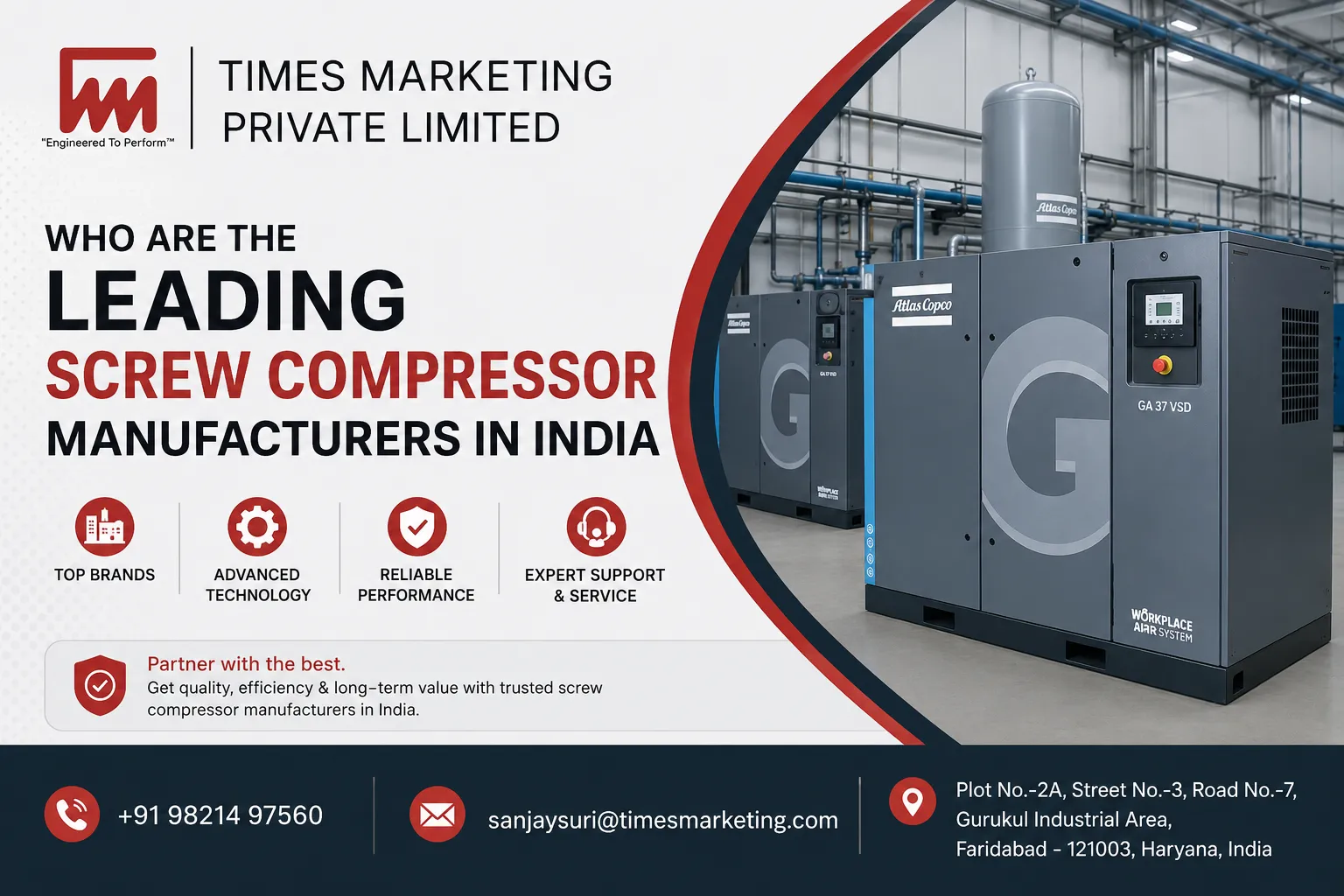
Among the manufacturers active in the Indian market, Atlas Copco screw compressors are widely recognized for their engineering consistency and global manufacturing standards. Atlas Copco designs and manufactures its own rotor and airend technology, which is a meaningful differentiator compared to assemblers who rely on third party cores.
The Atlas Copco rotary screw compressor range spans oil lubricated and oil free variants, fixed speed and VSD configurations, and covers applications from small workshops to large continuous process industries. As an authorized channel partner, Times Marketing supplies genuine Atlas Copco compressors along with the engineering support needed to size and install them correctly for Indian industrial conditions, which vary considerably in ambient temperature, dust levels, and power quality compared to many other markets.
That said, no single brand is the universal right answer for every application. The right choice depends on your specific air quality requirement, duty cycle, plant environment, and long term maintenance capability, which is exactly why a proper technical consultation matters more than brand loyalty alone.
Selection Matrix: Matching Compressor Type to Industry
| Industry | Typical Air Demand Pattern | Recommended Compressor Type |
|---|---|---|
| Automotive Manufacturing | Continuous, high volume | Oil lubricated rotary screw, VSD preferred |
| Pharmaceuticals | Continuous, contamination sensitive | Oil free screw compressor |
| Food and Beverage Processing | Continuous, hygiene critical | Oil free screw compressor with desiccant dryer |
| Textile Mills | Continuous, moderate volume | Oil lubricated rotary screw |
| Electronics and Precision Assembly | Variable, contamination sensitive | Oil free screw compressor, VSD |
| General Fabrication Workshops | Intermittent, lower volume | Smaller fixed speed rotary screw or piston |
| Process and Chemical Plants | Continuous, variable load | VSD rotary screw compressor |
Common Mistakes When Evaluating Screw Compressor Manufacturers
Mistake 1: Comparing Machines Purely on Motor Horsepower. Horsepower alone does not tell you actual air delivery. Two compressors with the same motor rating can have meaningfully different FAD output depending on airend efficiency and rotor design.
Mistake 2: Ignoring Ambient Operating Conditions. A compressor performing well in a controlled test environment may behave differently in a dusty, high temperature Indian factory floor. Ask manufacturers directly about derating factors for altitude and ambient temperature.
Mistake 3: Overlooking Spare Parts Localization. Some manufacturers import spare parts with long lead times, which can leave a plant waiting weeks for a critical component. Confirm local parts availability before finalizing a manufacturer.
Mistake 4: Choosing Based on Brand Recognition Alone. A well known name does not automatically mean the specific model matches your application. Always request an application specific sizing review rather than relying on a standard catalog recommendation.
Mistake 5: Underestimating Installation Requirements. Screw compressors generate heat and require proper ventilation, foundation, and piping design. Poor installation can undermine even the best engineered machine.
Maintenance Considerations Across Manufacturers
Regardless of which manufacturer you choose, rotary screw compressors share a common maintenance backbone. Following a preventive maintenance schedule, rather than reacting only after a failure, is the single biggest factor in extending compressor lifecycle and controlling total cost of ownership.
| Maintenance Task | Typical Frequency | Why It Matters |
|---|---|---|
| Oil and filter change (oil lubricated units) | As per running hours or manufacturer schedule | Prevents accelerated airend wear |
| Air filter inspection | Monthly | Protects intake air quality and airend longevity |
| Separator element replacement | As per running hours | Maintains oil carryover within limits |
| Belt or coupling inspection | Quarterly | Prevents mechanical transmission failure |
| Full technical service | Per manufacturer running hour intervals | Comprehensive check of bearings, seals, and controls |
| Leak testing across piping network | Periodic | Reduces energy waste from undetected leaks |
Did You Know? Industry studies on industrial compressed air systems consistently find that undetected leaks across piping networks can represent a substantial share of total compressed air energy loss, often more than plant operators initially estimate.
Buying Guide: How to Choose the Right Screw Compressor Manufacturer
Step 1: Calculate Your Actual Air Demand. Add up FAD requirements across all connected equipment, including a reasonable margin for future expansion, rather than sizing only for current usage.
Step 2: Determine Your Air Quality Class. Identify whether your process requires oil free air under ISO air purity classifications, or whether oil lubricated air with proper filtration is sufficient.
Step 3: Shortlist Manufacturers With Verified Engineering Credentials. Prioritize manufacturers with documented rotor and airend design capability over pure resellers.
Step 4: Request Application Specific Sizing, Not a Generic Catalog Match. A proper site assessment accounts for your ambient conditions, altitude, and duty cycle.
Step 5: Confirm Local Spare Parts and Service Availability. Ask specifically about response times and parts stock in your region.
Step 6: Evaluate Total Lifecycle Cost, Not Just the Machine Itself. Energy consumption and maintenance frequency matter more over a compressor's operating life than the initial specification sheet suggests.
Step 7: Plan Installation and Commissioning With the Same Care as the Purchase Decision. Even the best engineered rotary screw compressor underperforms if installed without proper piping, ventilation, and foundation planning.
Checklist Before Finalizing a Screw Compressor Manufacturer
- Verify whether the manufacturer designs its own airend or sources it from a third party
- Request FAD and power consumption data at your specific working pressure
- Confirm oil free or oil lubricated suitability for your application
- Ask about VSD availability if your air demand fluctuates
- Check local spare parts stock and average delivery time
- Request references from similar industries in your region
- Confirm installation and commissioning support is included
- Review preventive maintenance packages and response time commitments
Conclusion
Choosing among the various screw compressor manufacturers in India is not a decision that should be based on brand recognition or a single price comparison. The manufacturers worth serious consideration are the ones with verifiable engineering credentials, a genuine service and spare parts network, and a willingness to size their equipment against your actual plant conditions rather than a generic catalog match. A rotary screw compressor is a long term investment in your production reliability, and the right manufacturer relationship is what protects that investment over its full operating life.
Call to Action
If you are evaluating screw compressor manufacturers for a new installation, an expansion, or a replacement of aging equipment, Times Marketing can help you work through the technical details. Our team can assess your air demand, recommend the right configuration including genuine Atlas Copco screw compressors, and support you from installation through long term maintenance. Get in touch with Times Marketing to schedule a consultation, request a tailored product recommendation, or arrange a site assessment for your facility.