
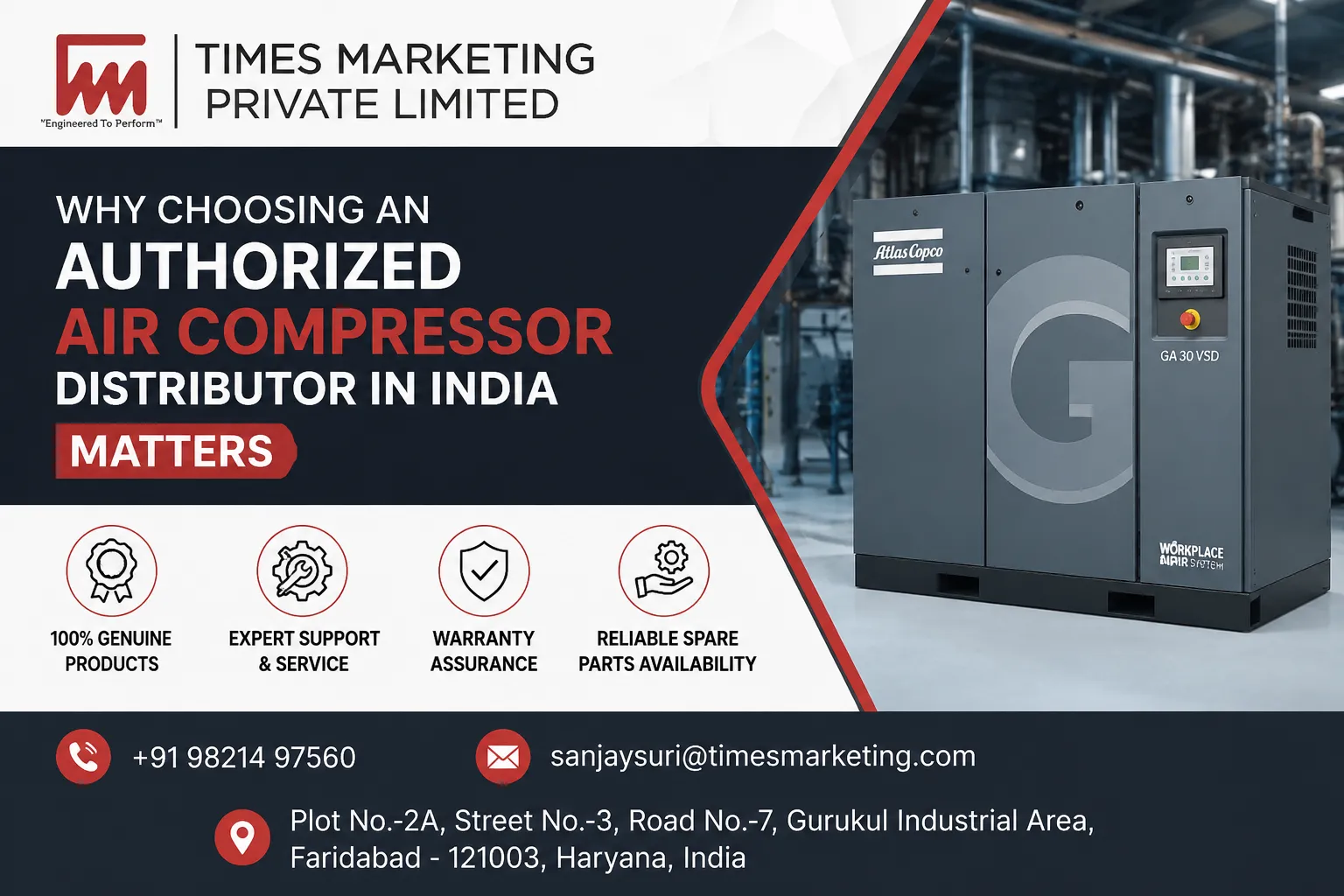
This is the reality many Indian manufacturers face when they treat compressed air equipment as a commodity purchase rather than a long term infrastructure decision. Choosing the right air compressor distributor in India is not just about finding a machine that fits your budget. It is about finding a partner who understands your application, stands behind the product with genuine support, and stays accountable long after the invoice is settled.
In this guide, we will walk through what actually separates an authorized distributor from a reseller, how to evaluate one properly, and what mistakes to avoid so your compressed air system keeps your production line running instead of holding it back.
What Does an Air Compressor Distributor Actually Do?
An air compressor distributor is the authorized bridge between a compressor manufacturer, such as Atlas Copco, and the end user, which in most cases is a factory, workshop, or industrial facility. A genuine distributor does far more than move boxes from a warehouse to your loading dock. Their responsibilities typically include:
- Technical consultation to match compressor capacity with your actual plant demand
- Installation guidance, including piping layout and air receiver sizing
- Supply of genuine spare parts with traceable batch and serial information
- Trained service engineers for commissioning, breakdown support, and preventive maintenance
- Warranty administration directly with the manufacturer
- Long term parts availability, even for older machine models
An unauthorized reseller, by contrast, usually stops at the sale. There is no accountability structure connecting them back to the manufacturer, which means if something goes wrong six months down the line, you are largely on your own.
Why Authorization Status Changes Everything
Did You Know? In India, compressor manufacturers typically certify only a limited number of distributors per region after evaluating their technical capability, service infrastructure, and spare parts inventory. This certification is not handed out casually.
Here is what authorization actually protects on the buyer's side:
Genuine Components. Authorized distributors source filters, separator elements, lubricants, and control parts directly from the manufacturer's approved supply chain. Grey market or duplicate parts, which are unfortunately common in India's industrial equipment resale ecosystem, can cause premature wear, inconsistent air quality, and voided warranties.
Warranty Validity. Most manufacturer warranties are conditional on the machine being purchased through, installed by, and serviced through an authorized channel. Buying through an unauthorized source can silently void this protection, something buyers often discover only after a failure occurs.
Technical Accuracy. Sizing a compressor incorrectly, whether in terms of CFM (cubic feet per minute), FAD (free air delivery), or working pressure in PSI or Bar, is one of the most common and costly mistakes in industrial procurement. Authorized distributors are trained directly by the manufacturer on correct sizing methodology, which reduces the risk of an oversized or undersized system.
Accountability Over Time. A distributor with an ongoing relationship with the manufacturer has a reputation to protect. That accountability tends to translate into faster response times and more honest troubleshooting.
Understanding Compressor Technology Before You Buy
Even the best distributor cannot help you if you do not understand the basics of what you are buying. A few technical fundamentals go a long way in every procurement conversation.
Rotary Screw Compressors use two interlocking helical rotors to compress air continuously. They are the standard choice for most medium to large industrial applications because they run efficiently at continuous duty cycles and produce a steady air supply.
Piston Compressors use pistons inside cylinders to compress air in short bursts. These are typically suited for smaller, intermittent use cases such as workshops or light fabrication units, rather than continuous production lines.
Oil Lubricated vs Oil Free Compressors. Oil lubricated machines are generally more cost effective to run and maintain, but the air they produce carries trace oil unless filtered. Oil free compressors are essential in industries like pharmaceuticals, food processing, and electronics, where even trace contamination is unacceptable under ISO air purity classifications.
VSD (Variable Speed Drive) Compressors automatically adjust motor speed to match real time air demand. This reduces energy wastage significantly compared to fixed speed machines that run at full power even during low demand periods.
Air Dryers and Filters. Compressed air naturally carries moisture, particulates, and in oil lubricated systems, trace oil vapor. Refrigerated or desiccant dryers, paired with the right filtration stages, protect downstream equipment and prevent corrosion in piping and tools.
Air Receivers. These storage tanks buffer pressure fluctuations and reduce the load cycling on the compressor itself, extending equipment life.
Understanding these fundamentals helps you have a more productive conversation with any distributor, and it makes it much harder for an unqualified seller to oversell equipment you do not actually need.
How to Evaluate an Air Compressor Distributor: A Practical Checklist
Use this checklist before finalizing any supplier for your facility.
- Confirm the distributor's authorization status directly with the manufacturer, not just through the distributor's own claims
- Ask for their service center location and average response time for breakdown calls
- Request references from existing industrial customers in your sector
- Verify that spare parts come with traceable documentation
- Ask whether they offer a site assessment before recommending a machine size
- Confirm what preventive maintenance packages are available
- Check whether installation support and commissioning are included
- Ask how they handle emergency downtime situations
- Review whether they stock parts for the specific model you are considering, not just newer models
Comparison Table: Authorized Distributor vs Unauthorized Reseller
| Factor | Authorized Distributor | Unauthorized Reseller |
|---|---|---|
| Spare Parts | Genuine, traceable, manufacturer approved | Often unverified or duplicate |
| Warranty | Valid and manufacturer backed | Frequently voided or unclear |
| Technical Sizing Support | Trained on manufacturer sizing standards | Inconsistent or generic advice |
| Installation Support | Structured commissioning process | Often limited or absent |
| After Sales Service | Dedicated trained technicians | Variable, sometimes outsourced |
| Long Term Parts Availability | Reliable, even for older models | Uncertain |
| Accountability | Backed by manufacturer relationship | Limited or none |
Compressor Selection Matrix by Industry Application
| Industry Type | Typical Requirement | Recommended Consideration |
|---|---|---|
| Automotive Manufacturing | Continuous high volume air demand | Rotary screw, oil lubricated or oil free depending on process |
| Pharmaceuticals | Zero contamination tolerance | Oil free compressor with medical grade filtration |
| Food and Beverage | Hygiene critical air quality | Oil free system with desiccant dryer |
| Textile Units | Moderate, continuous demand | Rotary screw with standard filtration |
| Electronics Assembly | Contamination sensitive, precision use | Oil free compressor, high purity filtration |
| Small Fabrication Workshops | Intermittent, lower volume | Piston compressor may suffice |
| Large Process Industries | High demand with variable load | VSD rotary screw for energy efficiency |
Common Mistakes Indian Buyers Make When Choosing a Distributor
Mistake 1: Prioritizing the Lowest Quote Without Comparing Scope. A lower quote often excludes installation support, extended warranty coverage, or genuine parts, all of which surface as hidden costs later.
Mistake 2: Skipping the Site Assessment. Every facility has different ambient temperature, altitude, dust levels, and layout constraints. A compressor recommended without a proper site evaluation is a guess, not an engineering decision.
Mistake 3: Ignoring Total Cost of Ownership. The purchase itself is only one part of a compressor's lifecycle cost. Energy consumption, maintenance frequency, and downtime risk matter far more over a ten year operating life.
Mistake 4: Not Verifying Genuine Parts Sourcing. Buyers sometimes assume all filters and spare parts are interchangeable across brands. This is rarely true, and mismatched parts can compromise both performance and safety.
Mistake 5: Overlooking After Sales Response Time. A distributor located far from your facility, with no local service infrastructure, can leave your plant idle for days during a breakdown.
Expert Tips for Long Term Compressed Air Reliability
Expert Tip: Schedule preventive maintenance based on operating hours, not calendar time alone. A compressor running three shifts wears differently than one running a single shift, even if both were installed on the same date.
Expert Tip: Conduct routine leak testing across your piping network. Industry studies on compressed air systems consistently show that undetected leaks can account for a significant share of total energy waste in a typical industrial facility.
Expert Tip: Monitor pressure drop across filters and dryers. A rising pressure drop is often the earliest warning sign of a component nearing the end of its service life, well before an actual failure occurs.
Expert Tip: Keep a maintenance log for every compressor on site. This becomes invaluable both for troubleshooting recurring issues and for demonstrating compliance during safety or energy audits.
Maintenance Schedule Overview
| Maintenance Type | Frequency | Purpose |
|---|---|---|
| Daily Visual Checks | Every shift | Detect leaks, unusual noise, or vibration early |
| Filter Inspection | Monthly | Prevent pressure drop and contamination |
| Oil and Lubricant Check | As per manufacturer guidance | Maintain lubrication performance |
| Belt and Coupling Inspection | Quarterly | Prevent mechanical wear related failures |
| Full Service by Trained Technician | As per running hours | Comprehensive preventive maintenance |
| Air Quality Testing | Periodically, per industry requirement | Ensure compliance with application specific standards |
Buying Guide: A Step by Step Approach
Step 1: Define Your Air Demand. Calculate your actual CFM or FAD requirement based on the tools, machinery, or processes that will run on compressed air, including a reasonable margin for future expansion.
Step 2: Identify Air Quality Requirements. Determine whether your process tolerates trace oil or requires an oil free system, based on your industry and end use.
Step 3: Evaluate Site Conditions. Consider ambient temperature, dust levels, altitude, and available space, since these affect compressor selection and cooling requirements.
Step 4: Shortlist Authorized Distributors. Verify authorization directly, request site assessments, and compare scope of service, not just the equipment itself.
Step 5: Review the Full System, Not Just the Compressor. A compressor is only one part of a system that includes dryers, filters, piping, and receivers. Evaluate the complete setup for compatibility.
Step 6: Confirm Maintenance and Support Terms. Clarify what after sales support looks like, including response times and spare parts availability, before finalizing your decision.
Step 7: Plan for Installation and Commissioning. Proper commissioning ensures the machine performs as designed from day one, rather than requiring corrective adjustments later.
Why Times Marketing
Times Marketing has built its reputation in the industrial equipment space by focusing on exactly the principles outlined above: genuine products, technically sound recommendations, and dependable after sales support. As a supplier serving industries across Delhi NCR, Bangalore, and other major industrial regions in India, Times Marketing offers a curated range of compressed air solutions, including Atlas Copco compressors, air dryers, filtration systems, piping, and genuine spare parts.
What sets a distributor like Times Marketing apart is not just the equipment on offer, but the engineering guidance that comes with it. From helping plant heads and procurement managers correctly size a compressor for their actual production demand, to supporting installation and ongoing maintenance, the goal is to make sure the compressed air system becomes a reliable part of daily operations rather than a recurring point of failure.
We do not believe in overselling. Every recommendation is grounded in what a facility actually needs, its limitations included, so that customers make informed decisions rather than ones driven purely by upfront cost.
Conclusion
Choosing the right air compressor distributor in India is a decision that shapes the reliability of your production line for years, not just the day the machine is installed. The difference between an authorized distributor and an unverified reseller often only becomes visible during a breakdown, and by then, the cost of that decision has already been paid in downtime, repairs, or lost output. A thoughtful evaluation process, grounded in technical understanding and honest questions about support and accountability, protects your investment far more effectively than chasing the lowest quote.
Call to Action
If your facility is planning a new compressed air installation, or if your current system has been giving you more downtime than answers, Times Marketing is here to help. Our team can walk through your site requirements, recommend the right compressor solution including genuine Atlas Copco equipment, and support you from installation through ongoing maintenance. Reach out to Times Marketing to schedule a consultation, request a product recommendation, or arrange an installation assessment for your facility.