
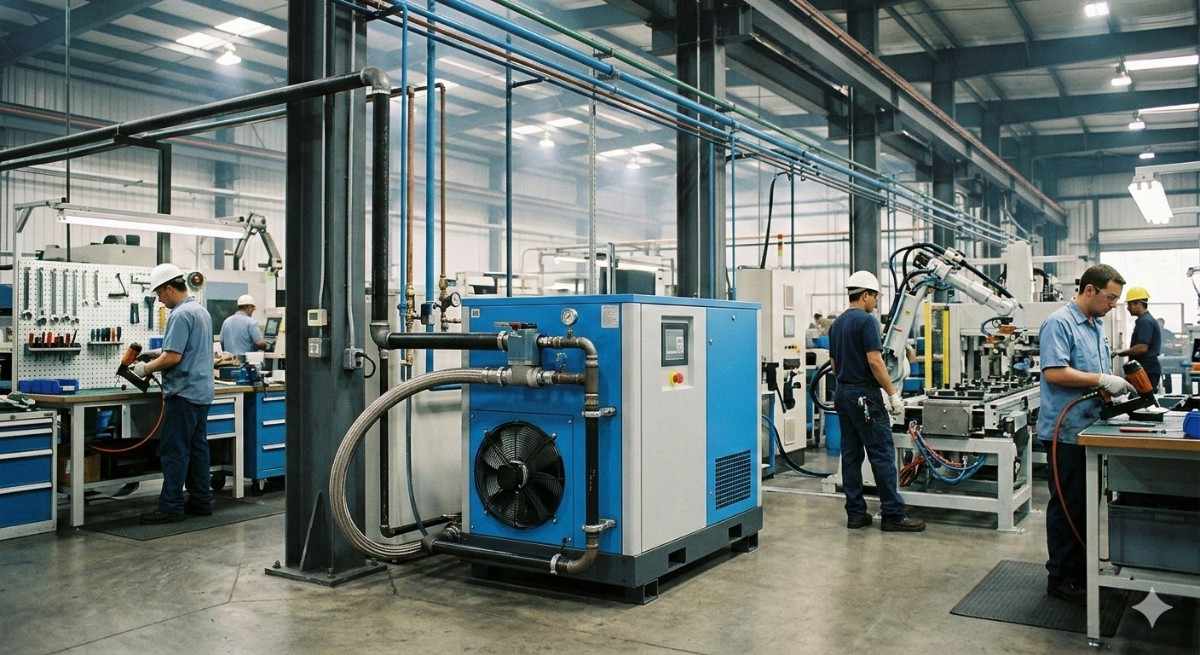
It is a Monday morning. Your production line is running at full capacity. Orders are piling up. Deadlines are tight.
Then suddenly, the air compressor fails.
Pneumatic tools stop working. The assembly line halts. Workers stand idle. Every minute of downtime costs your business money.
This is not a rare scenario. It happens to factories every day, and in most cases, it comes down to one thing: an unreliable or undersized industrial air compressor.
Compressed air is often called the fourth utility in manufacturing, right after electricity, water, and gas. It powers tools, drives automation, controls processes, and keeps production moving. Without a dependable industrial air compressor, even the most modern factory cannot function at its best.
In this guide, we will explain exactly why every factory needs a reliable industrial air compressor, what to look for when choosing one, and how Times Marketing can help you find the perfect solution for your facility.
What Is an Industrial Air Compressor?
An industrial air compressor is a machine that converts power (usually from an electric motor or diesel engine) into compressed air. This compressed air is stored in a tank and delivered through a piping system to power tools, machinery, and automated processes across your facility.
Unlike small portable compressors used for occasional tasks, an industrial air compressor is designed for:
- Heavy-duty, continuous use
- High air volume output (measured in CFM or liters per minute)
- High pressure delivery (measured in bar or PSI)
- Long operational life with minimal downtime
Industrial air compressors come in several types, including rotary screw compressors, reciprocating (piston) compressors, and centrifugal compressors. For most factories, the rotary screw industrial air compressor is the most popular choice due to its efficiency, reliability, and suitability for continuous operation.
Think of an industrial air compressor as the heart of your factory. Just as the heart pumps blood to every part of the body, the compressor pumps compressed air to every corner of your production facility.
Why Compressed Air Is Critical for Factory Operations
Before we get into choosing the right industrial air compressor, it helps to understand just how deeply compressed air is woven into factory operations.
Here are some of the most common applications of compressed air in a factory setting:
- Pneumatic tools: Drills, grinders, wrenches, and sanders all run on compressed air. They are lighter, more powerful, and safer than electric equivalents in many industrial environments.
- Automated production lines: Robotic arms, conveyor systems, and pick-and-place machines rely on compressed air for precise, repeatable motion.
- Spray painting and surface finishing: Consistent air pressure is essential for achieving uniform paint coverage in automotive and furniture manufacturing.
- Packaging and bottling: Air-driven filling, sealing, and labeling machines require a steady, clean air supply to maintain production speed and quality.
- Material handling: Pneumatic conveying systems use compressed air to transport powders, granules, and bulk materials through pipelines across the facility.
- Cooling and cleaning: Compressed air is used to cool components during machining and to blow away dust, chips, and debris from work surfaces.
Without a reliable industrial air compressor delivering consistent pressure and volume, all of these processes are at risk.
Key Benefits of a Reliable Industrial Air Compressor
Investing in the right industrial air compressor is not just about keeping machines running. It delivers real, measurable benefits to your entire operation.
1. Uninterrupted Production
A reliable industrial air compressor ensures your production line never stops due to air supply issues. Consistent airflow means consistent output, which means you meet your delivery deadlines without stress.
2. Higher Productivity
Compressed air tools work faster and with more power than many electric alternatives. Workers complete tasks more efficiently, which directly improves overall factory productivity.
3. Reduced Energy Costs
Modern industrial air compressors, especially those equipped with variable speed drive technology, are highly energy efficient. Since compressed air can account for 20 to 30% of a factory's electricity bill, upgrading to an efficient compressor can result in significant cost savings every month.
4. Improved Product Quality
Stable, clean compressed air leads to better results in painting, finishing, filling, and assembly processes. Pressure fluctuations or contaminated air can cause product defects and costly rework.
5. Safer Working Environment
Pneumatic tools powered by a well-maintained industrial air compressor are generally safer to operate than high-voltage electric tools, particularly in wet or hazardous environments.
6. Long-Term Cost Savings
A quality industrial air compressor, properly maintained, can last 10 to 15 years. The long lifespan and reduced maintenance requirements of premium models make them a far better investment than cheap, unreliable alternatives.
How to Choose the Right Industrial Air Compressor for Your Factory
With so many options available, choosing the right industrial air compressor can feel overwhelming. Here is a step-by-step approach to make the decision simpler:
Step 1: Calculate Your Total Air Demand Walk through your facility and list every piece of equipment that uses compressed air. Note the CFM (cubic feet per minute) or liters per minute requirement for each. Add them all up, then add a 20 to 25% safety buffer for future expansion.
Step 2: Determine Your Required Pressure Identify the maximum working pressure required by your equipment, measured in bar or PSI. Your industrial air compressor must comfortably meet or exceed this pressure at all times.
Step 3: Choose the Right Compressor Type For continuous, heavy-duty factory use, a rotary screw industrial air compressor is the most recommended choice. It runs 24/7 without overheating, delivers consistent airflow, and is highly energy efficient.
For intermittent or lighter applications, a reciprocating (piston) compressor may be sufficient, though it is less suitable for continuous operation.
Step 4: Decide Between Oil-Injected and Oil-Free If your factory produces food, beverages, pharmaceuticals, or electronics where air contacts the product, you need an oil-free industrial air compressor. For general manufacturing, metalworking, or automotive applications, oil-injected models offer excellent performance and value.
Step 5: Evaluate Energy Efficiency Look for compressors with high energy efficiency ratings. A variable speed drive industrial air compressor automatically adjusts its motor speed to match actual air demand, reducing energy waste significantly.
Step 6: Plan for Air Treatment Compressed air from the compressor is hot, wet, and potentially contaminated. Your system will need air dryers, filters, and separators to deliver clean, dry air to your production processes. Plan for these components as part of your overall compressed air system.
Step 7: Choose a Supplier With Strong After-Sales Support The compressor itself is only part of the equation. Choose a supplier who provides installation, commissioning, preventive maintenance, and fast spare parts availability. This is what truly protects your investment.
Common Industrial Air Compressor Problems and How to Solve Them
Even the best industrial air compressor can run into issues if not properly maintained. Here are the most common problems factory managers face and how to address them:
Problem 1: Compressor Not Building Pressure
Cause: Worn piston rings, leaking valves, or clogged air filter. Solution: Inspect and replace the air filter. Have a technician check the valves and internal components. Conduct a leak test on your piping system.
Problem 2: Overheating
Cause: Poor ventilation, dirty cooler, low oil level, or high ambient temperature. Solution: Ensure the compressor room has adequate ventilation. Clean the cooler fins regularly. Check and top up oil levels. Consider relocating the compressor if ambient temperatures are excessively high.
Problem 3: Excessive Moisture in the Air Lines
Cause: Faulty or undersized air dryer, or no dryer installed at all. Solution: Install or upgrade your refrigerated or desiccant air dryer. Moisture in compressed air lines causes rust, damages pneumatic tools, and ruins surface finishes.
Problem 4: High Energy Consumption
Cause: Air leaks in the piping system, an oversized compressor running at partial load, or an outdated fixed-speed model. Solution: Conduct a compressed air audit to identify and fix leaks. Consider upgrading to a variable speed drive industrial air compressor that matches output to demand.
Problem 5: Frequent Breakdowns
Cause: Lack of preventive maintenance, using non-genuine spare parts, or running the compressor beyond its rated capacity. Solution: Follow the manufacturer's maintenance schedule strictly. Always use genuine parts. If your factory's air demand has grown, it may be time to upsize your industrial air compressor.
Why Choose Times Marketing for Your Industrial Air Compressor Needs?
Finding the right industrial air compressor is one thing. Finding the right partner to help you select, install, and maintain it is another.
Times Marketing has built a strong reputation as a trusted compressed air solutions provider for factories across the region. Here is what sets them apart:
- Needs-Based Consultation: Times Marketing does not push products. Their team of compressed air specialists takes the time to understand your factory's specific requirements before recommending an industrial air compressor that truly fits.
- Complete Product Range: From compact 5 kW units for small workshops to large-scale 250 kW industrial air compressors for heavy manufacturing plants, Times Marketing has solutions for every application and budget.
- Turnkey Installation: From site assessment and system design to installation and commissioning, Times Marketing handles the entire process so you can focus on running your factory.
- Preventive Maintenance Programs: Their scheduled maintenance contracts keep your industrial air compressor in peak condition throughout the year, reducing the risk of unexpected breakdowns.
- Compressed Air Audits: Not sure where your energy is going? Times Marketing offers detailed compressed air system audits to identify leaks, inefficiencies, and upgrade opportunities that save you money.
- Genuine Spare Parts: Every service uses original, manufacturer-approved components to ensure your compressor performs exactly as designed.
- Fast Response Service: When a breakdown happens, response time matters. Times Marketing's trained service team is equipped to get your industrial air compressor back online as quickly as possible.
With Times Marketing, you are not just buying equipment. You are building a reliable compressed air infrastructure that supports your factory for years to come.
Frequently Asked Questions (FAQs)
Q1. What size industrial air compressor does my factory need? The right size depends on your total air demand (CFM or liters per minute) and required pressure (bar or PSI). As a general rule, calculate the combined air consumption of all your equipment and add a 20 to 25% buffer. Times Marketing can conduct a free assessment to help you determine the exact size needed.
Q2. How often should an industrial air compressor be serviced? Most industrial air compressors require a basic service every 2,000 operating hours and a major service every 4,000 hours. However, this varies by model and operating conditions. Following the manufacturer's maintenance schedule is essential for reliability and longevity.
Q3. What is the difference between a rotary screw and a piston industrial air compressor? A rotary screw industrial air compressor is designed for continuous, heavy-duty use and delivers a smooth, consistent airflow. A piston (reciprocating) compressor works in cycles and is better suited for intermittent or lighter applications. For most factories, the rotary screw model is the preferred choice.
Q4. Can one industrial air compressor power an entire factory? Yes, in many cases a single industrial air compressor of the right capacity can power an entire facility. For very large plants or those with widely separated production areas, a multiple-compressor system with a central controller may be more efficient.
Q5. How can I reduce compressed air energy costs in my factory? Start by fixing air leaks in your piping system, as leaks can waste up to 30% of compressed air. Upgrade to a variable speed drive industrial air compressor for better energy matching. Consider installing heat recovery systems to reuse the heat generated by the compressor for space or water heating.
Conclusion
Compressed air is not a background utility in your factory. It is a core part of your production infrastructure, and the industrial air compressor that delivers it deserves serious attention.
A reliable, well-sized, and properly maintained industrial air compressor keeps your production line running, your workers productive, your energy bills in check, and your product quality consistent.
Whether you are setting up a new factory, upgrading an aging compressor, or simply looking to improve the efficiency of your existing compressed air system, making the right choice now will save you time, money, and frustration for years to come.
Do not wait for a breakdown to take action.
Contact Times Marketing today for a free factory assessment and compressed air consultation. Their experts will help you find the right industrial air compressor for your facility and keep it performing at its best, day after day.
Reach out to Times Marketing and give your factory the reliable compressed air foundation it deserves.