
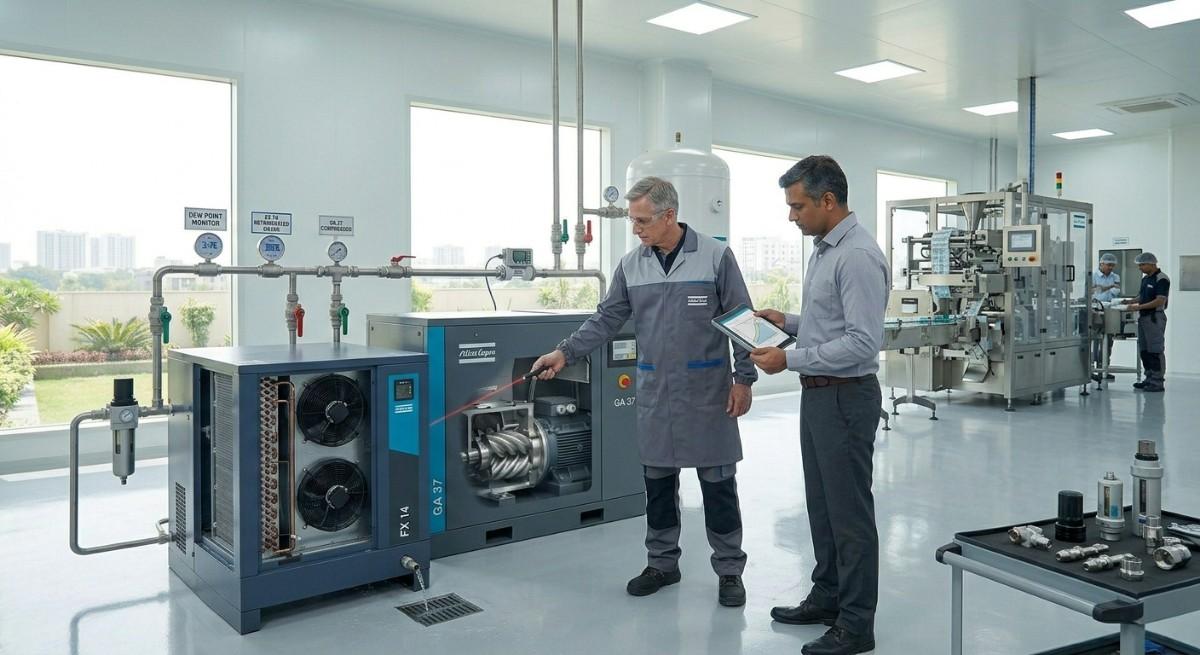
Every compressed air system in India has a silent enemy working against it every single day.
That enemy is moisture.
You cannot see it. You cannot hear it. But it is present in every cubic metre of air your compressor pulls in and it is constantly working to corrode your pipes, damage your tools, contaminate your products, and shorten the life of your expensive industrial equipment.
Thousands of plant managers and engineers across India deal with the consequences of moisture-laden compressed air every year without ever identifying the root cause of their problems.
Refrigerated air dryers are the most widely used and most cost-effective solution to this problem in industrial facilities across the country. If you are not already running one in your compressed air system this blog will show you exactly why you should be.
What Moisture Actually Does to Your Compressed Air System
Before exploring the benefits of refrigerated air dryers it is worth understanding exactly what uncontrolled moisture does to an industrial compressed air system over time.
When your compressor draws in ambient air it pulls in water vapour along with it. As the air is compressed and then cools inside your receiver tank and distribution pipework that water vapour condenses into liquid water.
This liquid water then travels through your air lines at high velocity reaching every valve, actuator, tool, and machine connected to your system.
In India the situation is made significantly worse by our climate. High ambient temperatures combined with extreme humidity during monsoon season means that Indian compressed air systems carry far higher moisture loads than systems operating in cooler and drier climates.
The damage this causes is real and measurable. Pneumatic tools wear out faster. Valves corrode and stick. Paint finishes develop defects. Pharmaceutical products fail quality checks. Production lines stop unexpectedly. Maintenance costs climb steadily.
All of this from a problem that refrigerated air dryers solve completely and cost-effectively.
How Refrigerated Air Dryers Work
Understanding how refrigerated air dryers work helps you appreciate why they are so effective and why they have become the standard solution for moisture removal across Indian industry.
The process is straightforward. Hot and moisture-laden compressed air from your compressor enters the dryer and passes through a heat exchanger where it is first pre-cooled by the outgoing dry air. It then enters the refrigeration circuit where it is cooled to approximately 3 degrees Celsius.
At this low temperature the water vapour in the compressed air condenses into liquid water. This liquid is collected and automatically drained out of the system through an automatic condensate drain valve.
The now-dry compressed air then passes back through the heat exchanger where it is rewarmed slightly by the incoming air. This rewarming prevents condensation from forming on the outside of your pipes and distribution system.
What leaves the dryer is clean, dry compressed air with a pressure dew point of typically 3 to 7 degrees Celsius. At this dew point liquid water will not form in your pipework or equipment under normal industrial operating conditions anywhere in India.
The entire process happens continuously, automatically, and with minimal energy consumption making refrigerated air dryers one of the most practical and reliable investments in any compressed air system.
Top Benefits of Refrigerated Air Dryers for Indian Industrial Facilities
Benefit 1: Complete Protection Against Moisture Damage
The most fundamental benefit of refrigerated air dryers is the one they are specifically designed to deliver. They remove moisture from your compressed air before it can reach your equipment.
This single benefit protects your entire downstream system including pneumatic cylinders, valves, actuators, tools, instrumentation, and production machinery from the corrosion, contamination, and mechanical damage that moisture causes.
For Indian facilities operating through monsoon season this protection is not just useful. It is essential for maintaining consistent year-round production.
Benefit 2: Significantly Extended Equipment Life
When your pneumatic equipment operates on clean dry compressed air it lasts significantly longer than equipment running on wet contaminated air.
Seals remain flexible and intact rather than swelling and degrading prematurely. Valve spool faces stay clean and move freely rather than corroding and sticking. Cylinder bores maintain their surface finish rather than pitting with rust.
The practical result is that your pneumatic tools, cylinders, valves, and instrumentation last substantially longer before needing repair or replacement. Across an entire production facility this translates to meaningful savings in capital expenditure on replacement equipment over the years.
Benefit 3: Dramatic Reduction in Maintenance Costs
One of the most immediately measurable benefits that plant managers notice after installing refrigerated air dryers is the drop in maintenance-related work orders across their facilities.
Fewer seized valves. Fewer corroded fittings. Fewer damaged tool internals. Fewer air line blockages caused by rust scale.
Maintenance teams that previously spent significant time dealing with moisture-related breakdowns find themselves free to focus on planned preventive maintenance rather than constant reactive repairs.
For Indian SMEs and manufacturing plants where maintenance resources are often stretched this reduction in reactive work is a genuinely significant operational benefit.
Benefit 4: Improved Product Quality Across Manufacturing Processes
In any manufacturing process where compressed air comes into contact with products or product surfaces the quality of that air directly affects the quality of the output.
Automotive paint shops experience fewer surface defects and fish-eye marks when the spray air is dry. Food packaging lines produce more consistent and hygienic results. Textile mills see fewer yarn breakages and fabric defects. Electronics assembly lines produce fewer moisture-related component failures.
Refrigerated air dryers ensure that the compressed air delivering these processes is consistently clean and dry regardless of the season or ambient humidity outside your facility.
Benefit 5: Reduced Energy Consumption Across the System
This is a benefit that surprises many plant managers when they first encounter it. Installing refrigerated air dryers can actually reduce the overall energy consumption of your compressed air system.
Moisture in compressed air increases the internal friction and flow resistance in your distribution pipework and connected equipment. Your compressor has to work harder to maintain system pressure against this increased resistance.
Dry compressed air flows more freely through your system. Your compressor reaches and maintains the required pressure with less effort which reduces its power consumption during normal operation.
In India where electricity costs are a significant operating expense for industrial facilities this energy saving contributes meaningfully to the return on investment from your refrigerated air dryer installation.
Benefit 6: Protection of Instrumentation and Control Systems
Modern manufacturing facilities rely heavily on pneumatic instrumentation and control systems. Flow meters, pressure transmitters, positioners, and control valves all require clean dry instrument air to operate accurately and reliably.
Moisture in instrument air causes erratic readings, control valve hunting, and premature failure of sensitive instrumentation components. These failures are not just expensive to repair. They can also cause significant process upsets and quality problems across your production operation.
Refrigerated air dryers provide the level of air dryness that keeps your instrumentation performing accurately and your control systems operating reliably day after day.
Benefit 7: Low Maintenance Requirements and High Reliability
One of the key reasons refrigerated air dryers have become so widely adopted across Indian industry is their combination of high reliability and low maintenance requirements.
Unlike desiccant dryers which require periodic replacement or regeneration of desiccant material, refrigerated air dryers have a closed refrigeration circuit that requires very little attention during normal operation.
The main routine maintenance tasks are cleaning the condenser fins periodically to maintain heat exchange efficiency and confirming that the automatic drain valve is functioning correctly. Beyond these simple tasks a well-installed refrigerated air dryer will operate reliably for many years with minimal intervention.
For Indian industrial facilities where consistent uptime is critical and maintenance resources are valuable this reliability is a major practical advantage.
Benefit 8: Consistent Performance Regardless of Season
India's seasonal climate swings from hot and dry in summer to hot and extremely humid during monsoon. This creates significant variation in the moisture load entering compressed air systems throughout the year.
A properly sized refrigerated air dryer handles this variation automatically. It continuously removes whatever moisture is present in the incoming air and delivers a consistent pressure dew point at the outlet regardless of whether it is January in Delhi or August in Mumbai.
This consistent year-round performance means your downstream equipment and processes receive the same quality of dry compressed air in every season without any adjustment or additional intervention from your team.
Industry Applications Across India
Refrigerated air dryers deliver tangible benefits across virtually every industrial sector in India. Here is how different industries rely on them.
Automotive Manufacturing and Paint Shops
Clean dry compressed air is essential in automotive spray booths to produce flawless paint finishes. Refrigerated air dryers ensure that moisture never reaches the spray equipment, delivering consistent surface quality across every vehicle that passes through the booth.
Pharmaceutical Production
While the most demanding pharma applications require desiccant level dryness, many supporting utilities and secondary processes in pharma plants use refrigerated air dryers to protect pneumatic equipment and maintain general air quality throughout the facility.
Food and Beverage Processing
Packaging lines, bottling operations, and pneumatic conveying systems in food and beverage facilities rely on clean dry air to maintain hygiene standards and equipment reliability. Refrigerated air dryers are the standard solution for these applications across Indian food processing facilities.
Textile Manufacturing
Air-jet looms and pneumatic yarn handling systems require consistent dry air throughout every operating shift. Refrigerated air dryers protect these systems from moisture damage and maintain consistent fabric quality in mills across Gujarat, Maharashtra, and Tamil Nadu.
General Manufacturing and Fabrication
From metal fabrication shops in Ludhiana to plastic processing units in Ahmedabad, refrigerated air dryers protect pneumatic tools and equipment across the full range of general manufacturing applications that form the backbone of Indian industry.
Warehousing and Packaging Operations
Automated packaging and palletising systems in large warehouses depend on reliable pneumatic equipment. Refrigerated air dryers ensure these systems operate without moisture-related failures in temperature and humidity conditions that vary significantly across different parts of India.
How to Choose the Right Refrigerated Air Dryer for Your Facility
Selecting the right refrigerated air dryer requires matching the specification carefully to your system and your operating conditions. Here are the key factors to consider.
Match the Flow Capacity to Your Compressor Output
Every refrigerated air dryer has a rated flow capacity. Select a dryer whose flow capacity matches or slightly exceeds your compressor's free air delivery. An undersized dryer cannot adequately process the full airflow from your compressor and your downstream equipment will still be exposed to moisture.
Check the Inlet Air Temperature Rating
Refrigerated air dryers are rated at a specific inlet air temperature, typically 35 degrees Celsius. If your compressed air enters the dryer at a higher temperature than the rated value the dryer's moisture removal efficiency will be reduced. In Indian conditions where summer temperatures can be extreme this is an important specification to confirm.
Confirm the Ambient Temperature Rating
Standard refrigerated air dryers are typically rated for ambient temperatures up to 45 degrees Celsius. If your compressor room regularly exceeds this temperature during Indian summers you will need a dryer specified for high ambient conditions to maintain reliable performance throughout the year.
Specify an Automatic Drain Valve
Always specify an automatic condensate drain valve with your refrigerated air dryer. Manual drain valves depend entirely on operator discipline to function correctly. Automatic drain valves remove condensate reliably on every cycle without any operator intervention, eliminating the risk of condensate backing up into your air system.
Consider Your Future Expansion Requirements
If you plan to add compressor capacity or increase production in the coming years it is worth considering a slightly larger dryer from the beginning. Upgrading a dryer after the fact involves additional installation work and cost that could be avoided with a modest increase in initial specification.
Look for Energy Efficient Models
Modern refrigerated air dryers incorporate energy saving features such as variable speed refrigeration compressors and intelligent load-sensing controls that reduce power consumption during periods of lower air demand. For facilities running compressed air systems around the clock these energy savings are worth evaluating when selecting your dryer.
Common Mistakes to Avoid When Installing Refrigerated Air Dryers
Installing the Dryer Without an Aftercooler
Compressed air leaving your compressor can be extremely hot. Most refrigerated air dryers require inlet air at or below a specified temperature to operate correctly. Without an aftercooler to reduce the air temperature before it enters the dryer the refrigeration system will be overloaded and moisture removal efficiency will be significantly reduced.
Undersizing the Dryer to Reduce Cost
Choosing a smaller dryer to save on initial cost is one of the most common mistakes Indian buyers make. An undersized dryer cannot keep up with your compressor's air output and the result is wet air reaching your downstream equipment which defeats the entire purpose of the installation.
Neglecting Condenser Cleaning
The condenser fins on a refrigerated air dryer collect dust and debris over time. Blocked condenser fins reduce heat exchange efficiency, cause the refrigeration circuit to work harder, and ultimately result in higher outlet dew points meaning wetter compressed air. Regular cleaning is simple and essential.
Ignoring the Drain Valve
The automatic drain valve on your refrigerated air dryer removes the condensate that the dryer collects. If this valve fails in the closed position condensate accumulates inside the dryer and eventually carries over into your air system. Check the drain valve operation regularly as part of your routine maintenance.
Placing the Dryer in a Poorly Ventilated Location
Refrigerated air dryers reject heat from the refrigeration process to the surrounding environment. If the dryer is installed in a small poorly ventilated room the ambient temperature around the dryer will rise and its performance will degrade. Always ensure adequate ventilation around your dryer installation.
Frequently Asked Questions About Refrigerated Air Dryers
Q1. What is the difference between a refrigerated air dryer and a desiccant air dryer?
A refrigerated air dryer cools the compressed air to condense and remove moisture, achieving a pressure dew point of around 3 to 7 degrees Celsius. A desiccant air dryer uses a chemical drying material to absorb moisture and can achieve much lower dew points down to minus 40 degrees Celsius or below. Refrigerated dryers are suitable for the majority of general industrial applications. Desiccant dryers are used when very low dew points are genuinely required by the application.
Q2. Do refrigerated air dryers work effectively during Indian monsoon season?
Yes. A properly sized refrigerated air dryer will handle the increased moisture load present in compressed air during high humidity monsoon conditions and continue to deliver a consistent outlet dew point throughout the season. The key is correct sizing based on the worst-case inlet conditions your system will experience.
Q3. How much electricity does a refrigerated air dryer consume?
Power consumption depends on the flow capacity of the dryer. Smaller dryers for workshop-scale compressors consume modest amounts of electricity that are far outweighed by the maintenance savings and equipment protection they deliver. Larger industrial dryers consume proportionally more but modern energy-efficient models minimise running costs through intelligent load-sensing controls.
Q4. Can a refrigerated air dryer be added to an existing compressed air system?
Yes. A refrigerated air dryer can be retrofitted to any existing compressed air system. It is installed in the main air line typically between the aftercooler and the air receiver tank. Installation is straightforward and can usually be completed without significant disruption to your existing system.
Q5. What maintenance does a refrigerated air dryer require?
Routine maintenance for a refrigerated air dryer is minimal. The condenser fins should be cleaned periodically to maintain efficiency. The automatic drain valve should be checked weekly for correct operation. An annual service by a qualified engineer covers the refrigerant circuit, electrical connections, and overall performance verification.
Q6. Will a refrigerated air dryer eliminate all oil contamination from my compressed air?
No. A refrigerated air dryer removes moisture from compressed air but it does not remove oil aerosols or oil vapour. Oil removal requires a coalescing filter and in applications requiring very low oil content an activated carbon filter installed downstream of the dryer. A complete filtration and drying system addresses both moisture and oil contamination together.
Q7. How long does a refrigerated air dryer last?
A well-maintained refrigerated air dryer from a reputable manufacturer will typically provide many years of reliable service in industrial conditions. Regular maintenance, clean condenser fins, and a correctly functioning drain valve are the key factors that determine the operational life of the unit.
Why Times Marketing Is the Right Partner for Your Refrigerated Air Dryers Needs
At Times Marketing we have years of hands-on experience helping Indian industrial facilities solve moisture problems and build reliable compressed air systems that perform consistently through every season.
We supply a carefully selected range of refrigerated air dryers covering every flow capacity from small workshop installations to large multi-compressor industrial systems.
Our technical team will assess your compressor output, your application requirements, and your specific operating environment before recommending the right dryer specification for your facility.
We back every installation with genuine spare parts support, qualified service engineers, and the kind of after-sales relationship that keeps your compressed air system performing at its best year after year.
Conclusion
Moisture in compressed air is a problem that affects every industrial facility in India. It damages equipment, reduces product quality, increases maintenance costs, and causes production downtime that hurts your business every single time it happens.
Refrigerated air dryers are the most practical, reliable, and cost-effective solution to this problem for the majority of Indian industrial applications. The benefits they deliver across equipment life, maintenance costs, product quality, and energy efficiency make them one of the smartest investments you can make in your compressed air system.
If your facility is not yet running refrigerated air dryers this is the right time to change that.
Contact the Times Marketing team today. We will help you choose the right refrigerated air dryer for your application and make sure it is installed correctly for maximum performance and long-term reliability.