
Picture this. A textile plant in Surat has been running smoothly for years. Then one monsoon season the quality of their fabric starts dropping. Yarn breakages increase. The air-jet looms keep stopping unexpectedly. The maintenance team is puzzled.
After weeks of troubleshooting an engineer finally identifies the root cause. Moisture in the compressed air system has been gradually damaging the loom valves and contaminating the air supply during the high humidity months.
The fix was simple. An air dryer compressor installed inline with the existing system solved the problem entirely within days.
This is not an unusual story. It plays out across factories, workshops, and processing plants all over India every single year. And in almost every case the solution is the same.
If you have ever wondered what an air dryer compressor is, how it works, and whether your facility actually needs one, this guide answers every question you have.
The Hidden Problem Inside Every Compressed Air System
Before understanding what an air dryer compressor does, you need to understand the problem it solves.
When your compressor draws in ambient air it does not just pull in oxygen and nitrogen. It pulls in water vapour as well. In fact every cubic metre of air contains a measurable amount of moisture that varies with the temperature and humidity of your environment.
As the compressor squeezes that air into a smaller volume the pressure rises and the air gets hot. When that hot compressed air then cools inside your pipes and receiver tank, the water vapour condenses into liquid water.
This liquid water travels through your air lines and reaches every tool, valve, actuator, and machine connected to your system.
In India the problem is significantly worse than in many other countries. Our climate combines high temperatures with high humidity levels for much of the year. Cities like Mumbai, Chennai, Kolkata, and Kochi experience ambient humidity levels that can push moisture loading in compressed air systems to levels that cause serious damage within a single monsoon season.
The result is rust inside your air lines and receiver tank, damaged pneumatic tools and valves, contaminated products in sensitive manufacturing processes, increased maintenance costs, and unexpected production downtime.
An air dryer compressor is the solution that eliminates this moisture before it can cause any of these problems.
What Is an Air Dryer Compressor
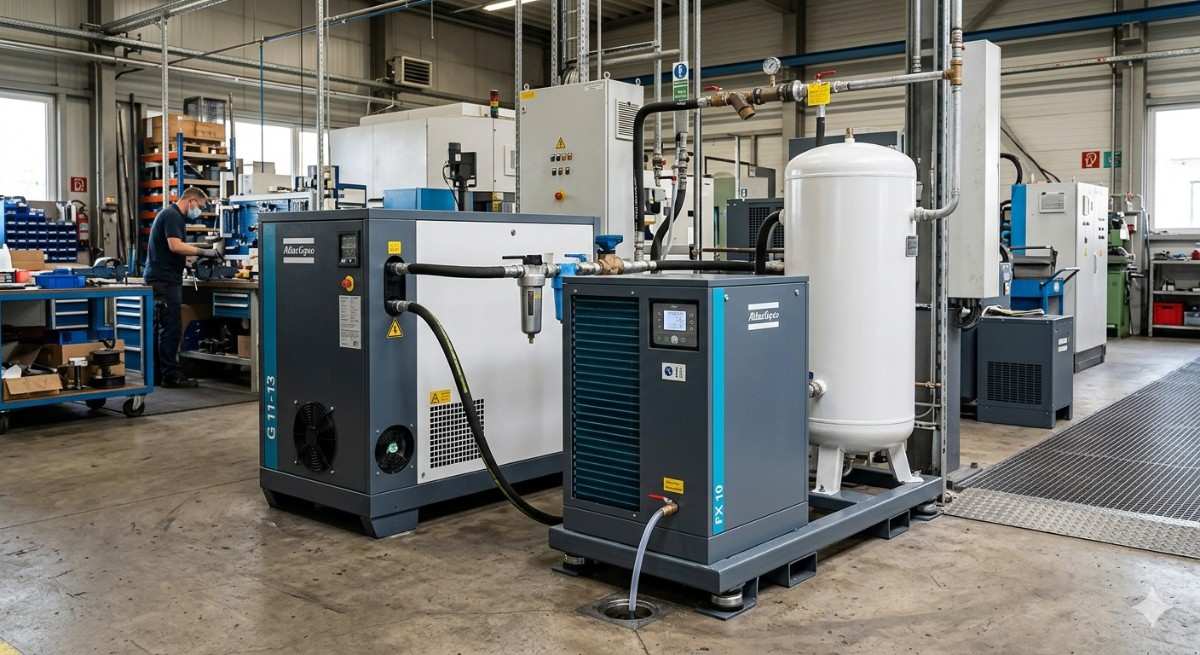
An air dryer compressor is not a single machine in the way the name might suggest to a first-time buyer. It refers to the combination of a compressed air dryer integrated into or installed alongside your compressor system to remove moisture from the compressed air before it reaches your downstream equipment.
The air dryer sits between your compressor and your air distribution system. Every cubic metre of air produced by your compressor passes through the dryer where moisture is removed before the dry air continues to your tools, machines, and production processes.
The result is clean, dry compressed air that protects your equipment, maintains product quality, and keeps your operations running reliably throughout the year regardless of the season or ambient humidity conditions.
Understanding the different types of air dryers available is the next step in making the right choice for your specific application.
Types of Air Dryer Compressor Systems Available in India
Not all air dryers work the same way and not all of them are suited to every application. Here is a clear explanation of the main types available to Indian industrial buyers.
Refrigerated Air Dryer
This is the most widely used type of air dryer in Indian industry and the right choice for the majority of general industrial applications.
A refrigerated air dryer works by cooling the compressed air to a low temperature, typically around 3 degrees Celsius. At this temperature the water vapour condenses into liquid water which is then separated and drained away automatically. The now-dry air is reheated slightly before leaving the dryer to prevent pipe sweating.
Refrigerated dryers achieve a pressure dew point of around 3 to 7 degrees Celsius. This is sufficient for most industrial applications including pneumatic tools, general manufacturing, automotive workshops, and packaging lines.
They are cost-effective, energy efficient, reliable, and require minimal maintenance making them the most popular choice for SMEs and large manufacturing plants alike across India.
Desiccant Air Dryer
A desiccant air dryer uses a chemical drying material called a desiccant, typically activated alumina or silica gel, to absorb moisture from compressed air. It achieves much lower pressure dew points than a refrigerated dryer, sometimes as low as minus 40 degrees Celsius or below.
This extremely dry air is required in applications where even trace amounts of moisture would cause serious problems. Pharmaceutical manufacturing, electronics assembly, instrument air systems, and certain chemical processing applications all require desiccant level dryness.
Desiccant dryers are more expensive to purchase and operate than refrigerated models. The desiccant material requires regular regeneration or replacement. However for the industries that need this level of dryness there is simply no alternative.
Membrane Air Dryer
A membrane dryer uses a bundle of hollow fibres to selectively allow water vapour to pass through the membrane wall while retaining the dry air. These dryers have no moving parts, require no electricity to operate, and are extremely compact.
They are used in specific niche applications such as instrument air systems, remote locations without power access, and small point-of-use drying requirements. They are not typically used for large centralised compressed air systems.
Deliquescent Air Dryer
These dryers use a hygroscopic salt tablet that dissolves as it absorbs moisture from the compressed air. They are simple, have no moving parts, and require no power but they do require regular replenishment of the desiccant salt and are limited in the dew point they can achieve.
They are used mainly in construction and mining applications where simplicity and portability are more important than achieving very low dew points.
Why Indian Industries Cannot Afford to Ignore an Air Dryer Compressor
India's industrial climate makes moisture in compressed air a more serious issue here than in many other countries. Here is exactly what happens when facilities operate without proper air drying.
Accelerated Equipment Wear
Moisture in compressed air causes rust and corrosion inside pneumatic cylinders, valves, and actuators. Seals swell and degrade. Moving parts wear faster. Equipment that should last five to seven years may need replacement in two to three years without proper air drying.
Increased Maintenance Costs
Corroded air lines, seized valves, and damaged tools all require frequent attention from your maintenance team. The cumulative cost of these repairs over a year consistently exceeds the cost of a quality air dryer compressor system many times over.
Product Quality Problems
In industries like food processing, pharmaceuticals, electronics, and automotive painting, moisture contamination directly affects product quality. A single batch of contaminated products can result in rejection costs and customer complaints that far outweigh the entire capital cost of an air drying system.
Production Downtime
Unexpected equipment failures caused by moisture damage are one of the leading causes of unplanned production downtime in Indian manufacturing facilities. Every hour of downtime has a direct and measurable cost to your business.
Energy Waste
Moisture in compressed air lines increases the friction and resistance in your system. Your compressor has to work harder to maintain pressure which directly increases your electricity consumption. In India where power costs are significant this energy waste adds up to a meaningful amount over the course of a year.
Real-World Applications Across Indian Industries
Here is how different industries across India benefit from installing an air dryer compressor in their compressed air system.
Pharmaceutical Manufacturing
Compressed air is classified as a process utility in pharma manufacturing. Regulatory guidelines require it to be free from moisture, oil, and microbial contamination. A properly specified air dryer compressor combined with appropriate filtration is not optional in this industry. It is a compliance requirement.
Automotive Paint Shops
Water droplets in compressed air used for spray painting cause surface defects, fish-eye marks, and adhesion failures in paint finishes. These defects require rework that is time-consuming and expensive. A refrigerated air dryer eliminates moisture from the air supply completely and produces consistently flawless paint finishes.
Food and Beverage Processing
Compressed air used in food packaging, bottling, and processing must meet food-grade quality standards. Moisture contamination in these applications affects product shelf life, packaging integrity, and hygiene compliance. Both refrigerated and desiccant dryers are used depending on the specific purity requirement.
Electronics Manufacturing
Circuit board assembly and semiconductor manufacturing require extremely dry compressed air. Even small amounts of moisture can cause short circuits, corrosion of components, and failures during testing. Desiccant dryers providing very low dew points are standard in these environments.
Textile Mills
Air-jet looms and other pneumatic textile machinery require clean dry air throughout every operating shift. Moisture in the air causes yarn breakages, fabric defects, and machine stops that reduce productivity significantly. Refrigerated dryers are the standard solution across textile manufacturing facilities in Gujarat, Maharashtra, and Tamil Nadu.
General Manufacturing and Fabrication
Even in general manufacturing environments where air purity is not a critical process requirement, an air dryer compressor protects pneumatic tools, extends equipment life, and reduces maintenance costs significantly across the production facility.
How to Choose the Right Air Dryer Compressor for Your Facility
Choosing the right air dryer requires matching the dryer specification to your compressor output, your application requirements, and your operating environment. Here is what to consider.
Match the Dryer to Your Compressor Flow Rate
Every air dryer has a rated flow capacity specified in CFM or litres per minute. Always select a dryer with a flow capacity that matches or slightly exceeds your compressor's free air delivery. An undersized dryer will not adequately dry the full air output and your downstream equipment will still be exposed to moisture.
Determine the Required Pressure Dew Point
For general industrial applications a refrigerated dryer delivering a 3 to 7 degree Celsius pressure dew point is sufficient. For instrument air, pharma, electronics, and other sensitive applications a desiccant dryer delivering minus 20 to minus 40 degrees Celsius dew point will be required. Confirm your application's dew point requirement before selecting a dryer type.
Consider Your Ambient Conditions
Refrigerated dryers have ambient temperature operating limits, typically up to 45 degrees Celsius for most standard models. If your compressor room regularly exceeds this temperature during Indian summers you will need a dryer rated for higher ambient conditions or alternative cooling arrangements.
Check Inlet Air Temperature
The air leaving your compressor is hot, sometimes over 80 degrees Celsius. Most dryers require an aftercooler to reduce the inlet air temperature before it enters the dryer. Confirm whether your system already has an aftercooler or whether one needs to be included in the installation.
Factor in Operating Costs
Refrigerated dryers consume electricity to run their refrigeration circuit. Desiccant dryers consume compressed air for regeneration which represents an energy cost. Evaluate both capital cost and ongoing operating cost when making your selection to understand the true total cost of ownership.
Look for Automatic Drain Valves
Your air dryer will collect liquid condensate that must be removed from the system. Always specify an automatic drain valve rather than relying on manual draining. Missed manual draining allows condensate to back up into the air system and defeats the purpose of having a dryer entirely.
Frequently Asked Questions About Air Dryer Compressor Systems
Q1. Do I need an air dryer if I already have an air receiver tank?
Yes absolutely. An air receiver tank does allow some natural condensation and separation of moisture but it cannot dry your compressed air to a level that adequately protects your equipment. A receiver tank and an air dryer serve different purposes and both are needed in a properly designed compressed air system.
Q2. What is pressure dew point and why does it matter?
Pressure dew point is the temperature at which water vapour in your compressed air will condense into liquid water at the operating pressure of your system. The lower the pressure dew point the drier your air. Matching the correct dew point to your application ensures your air is dry enough to protect your equipment without overspending on drying capacity you do not need.
Q3. How much electricity does a refrigerated air dryer consume?
A typical refrigerated air dryer for a 10 to 20 CFM compressor will consume between 0.3 and 0.8 kilowatts of electricity. Larger dryers for higher flow rates consume proportionally more. The energy cost is modest compared to the maintenance savings and equipment protection that dry compressed air provides across your facility.
Q4. Can I install an air dryer on an existing compressed air system?
Yes. An air dryer can be retrofitted to any existing compressed air system. It is installed in the main air line between the compressor outlet and your air receiver tank or distribution system. A qualified technician can complete the installation without major disruption to your existing setup.
Q5. How often does a refrigerated air dryer need servicing?
Refrigerated air dryers require relatively little maintenance. The automatic drain valve should be checked weekly. The condenser fins should be cleaned periodically to maintain heat exchange efficiency, typically every three to six months depending on your environment. Annual servicing by a qualified engineer will keep your dryer performing at its rated efficiency throughout its service life.
Q6. What happens if I run my air dryer compressor system without regular maintenance?
A poorly maintained air dryer loses efficiency over time. The pressure dew point rises meaning your compressed air becomes progressively wetter. Blocked drain valves allow condensate to re-enter the air system. Dirty condenser fins cause the refrigeration circuit to work harder and consume more electricity. Regular maintenance keeps the dryer performing exactly as intended.
Q7. Is a desiccant dryer always better than a refrigerated dryer?
Not at all. A desiccant dryer achieves a much lower dew point than a refrigerated dryer but it also costs significantly more to purchase and operate. For the majority of general industrial applications in India a well-sized refrigerated air dryer provides perfectly adequate air dryness at a fraction of the cost. Desiccant dryers are the right choice only when your application genuinely requires a very low pressure dew point.
Why Times Marketing Is Your Trusted Air Dryer Compressor Partner in India
At Times Marketing we have helped hundreds of industrial facilities across India solve moisture problems in their compressed air systems with the right air dryer solution.
We supply a complete range of refrigerated and desiccant air dryers sized for every application from small workshops to large manufacturing plants.
Our technical team will assess your compressor output, your application requirements, and your operating environment before recommending any product. We do not offer one-size-fits-all solutions because we know that every facility is different.
Every air dryer we supply comes with full installation support, genuine spare parts availability, and after-sales service from qualified engineers who understand compressed air systems inside and out.
Conclusion
Moisture in compressed air is one of the most damaging and most preventable problems in Indian industrial operations. An air dryer compressor system is the solution that eliminates this problem completely and protects every piece of equipment your business depends on.
Whether you run a small workshop, a mid-size manufacturing unit, or a large industrial plant the right air dryer will pay for itself many times over through reduced maintenance costs, longer equipment life, better product quality, and fewer hours of unplanned downtime.
Do not wait for a moisture-related breakdown to make the decision. Contact the Times Marketing team today and let us help you choose the right air dryer compressor solution for your facility.