
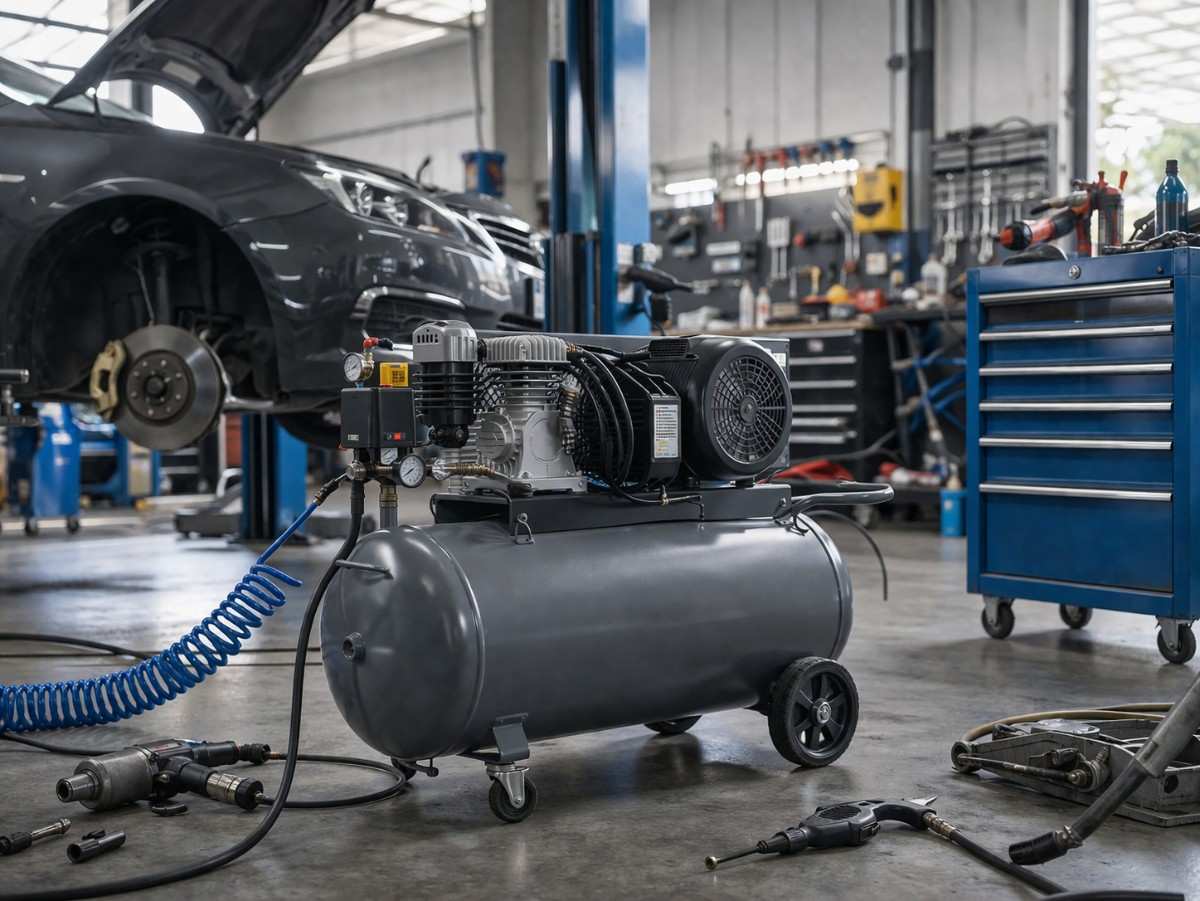
The Silent Problem That Steals Your Workshop Profits Every Day
Walk into any busy automotive workshop in India. A bustling commercial garage in Delhi. A high end detailing studio in Mumbai. A tyre repair shop on a highway.
What is the one sound you will always hear?
It is not just the clanking of tools or the revving of engines.
It is the steady, powerful hum of an air compressor.
That sound is the heartbeat of your productivity. When it stops, everything stops. Your technicians wait. Customers wait. Revenue leaks away.
As a plant manager, garage owner, or engineer, you already know this truth. Without reliable compressed air, your entire operation comes to a grinding halt.
A Real Scene Every Workshop Owner Knows
Let me paint a picture you will recognise.
It is a busy Wednesday morning. Three cars are waiting for paint jobs. Your best painter picks up the spray gun. Instead of a smooth, glossy finish, the paint sputters and spits onto the panel.
Why?
Because your old compressor is pushing out moist, oily air.
Now you have to sand it down and repaint. The damage is done.
-
You waste two hours of labour
-
You waste expensive paint and materials
-
You lose customer trust
-
That customer may never come back
This happens more often than most workshop owners care to admit. And the root cause is almost always the same. A poorly chosen or poorly maintained automotive air compressor.
What Exactly Are Automotive Air Compressors? A Simple Explanation
Let me keep this simple. No complicated engineering jargon.
An automotive air compressor is a device that takes in ambient air and squeezes it into a smaller volume. This squeezing increases the air pressure. That high pressure air gets stored in a tank. When you need power, you release that air through a hose to run your tools.
Think of it as a battery for your workshop.
-
You charge the battery by filling the tank with air
-
You store that energy in the tank
-
You use that stored energy to power multiple tools throughout the day
The Two Main Types You Will Find in Indian Workshops
Piston type compressors are the workhorses of small and medium garages. They use a cylinder and a piston, just like a small engine.
Screw type compressors are for heavy duty, non stop use. They use two rotating screws to compress air.
Here is how they compare at a glance:
-
Piston type: Affordable, durable, easy to maintain, ideal for intermittent use
-
Screw type: Quieter, continuous air supply, higher upfront cost, ideal for large workshops
Why Your Workshop Cannot Compromise on Air Quality
In an Indian context, this becomes even more critical.
Our ambient humidity is high. Dust is everywhere. Power fluctuations are common. Your equipment needs to handle tough conditions without breaking down every other week.
A quality automotive air compressor does two things very well.
-
It delivers a consistent volume of air so your tools run at full power
-
It delivers clean, dry air so your paint jobs and precision work are flawless
For tasks like painting or precision braking systems, moisture is the enemy. For impact wrenches and ratchets, consistent pressure is non negotiable.
Key Benefits of Upgrading Your Workshop Air Compressor
Why should you consider a new unit? Here is what a modern automotive air compressor brings to your floor.
Faster Job Completion
-
High CFM means tools run at full power continuously
-
No waiting for the tank to refill between tasks
-
Your technicians finish more cars per day
Lower Electricity Bills
-
Newer efficient motors consume less power
-
In India, power costs are a major operational expense
-
Savings show up directly on your bottom line
Less Downtime
-
Reliable brands with local service support fix issues fast
-
Your compressor gets repaired quickly when something goes wrong
-
No more waiting weeks for spare parts
Better Tool Life
-
Clean, dry, properly pressured air extends tool life
-
Your impact wrenches, ratchets, and spray guns last longer
-
You spend less money replacing tools
Safer Workplace
-
No hot exhaust fumes like a petrol engine
-
No electrical shock risks near water
-
Compressed air is clean, safe power
For a garage owner, this translates directly to higher customer satisfaction and better profit margins.
Real World Applications in Indian Automotive Shops
Let us get practical. Where exactly will you use this machine?
Tyre and Wheel Bay
Every puncture shop and wheel alignment centre needs continuous air for tyre changing machines and impact wrenches.
-
A good compressor means your technician does not wait between wheels
-
Tyre inflation is quick and accurate
-
Customer waiting time reduces significantly
Paint and Body Shop
This is the most demanding application. Spray painting needs a constant, dry, oil free air supply.
-
Any fluctuation or contamination ruins the finish
-
Many high end workshops now install a dedicated small compressor just for their paint booth
-
Your paint quality becomes consistent every time
Mechanical Repair Bays
From removing stubborn nuts with an impact wrench to using an air ratchet in tight spaces, air tools are superior.
-
Air tools are faster than electric ones
-
They are lighter and cause less technician fatigue
-
Your mechanics work faster and feel less tired by the end of the day
Car Detailing and Cleaning
-
Blow guns remove dust from dashboards and engine bays
-
Foam cannons for car washes use compressed air to create thick, clinging foam
-
Detailing studios love the versatility of compressed air
Manufacturing and Assembly
If your business is part of an OEM supply chain or you manufacture automotive components, you need a heavy duty industrial screw compressor.
-
It will run two shifts daily without complaint
-
Consistent air pressure ensures consistent product quality
-
Production never stops due to air failure
How to Choose the Right Automotive Air Compressor: A Buying Guide for India
Now for the most important part. How do you pick the right one for your workshop?
Step 1: Calculate Your Air Demand
List all the tools you plan to run simultaneously.
-
Each tool has a CFM rating at a specific pressure (PSI or bar)
-
Add up the CFM of the tools you will use at the same time
-
Then add 20% extra to be safe
Step 2: Decide on Tank Size
-
Small two car garage with intermittent use: 50 to 100 litre tank
-
Busy workshop with 4 to 5 bays: 200 to 300 litre tank
-
Heavy continuous use: You might not need a large tank if you choose a screw compressor
Step 3: Match Power Supply to Your Facility
In India, this is a critical check.
-
Small compressors run on single phase 230V power
-
Larger industrial units need three phase 415V power
-
Check your workshop electrical panel before buying
Step 4: Choose Between Piston and Screw
-
Piston type: Upfront cheaper, good for intermittent use
-
Screw type: Higher initial cost, much lower running cost, quieter operation
Step 5: Look for Service Support
This is where many buyers make a costly mistake.
-
A compressor is a long term asset
-
Ask about service network in your city
-
Check spare parts availability
-
Ask about annual maintenance contracts
Step 6: Check for Air Treatment
Do not forget the dryer and filters. This is non negotiable for paint work.
-
An aftercooler removes heat from compressed air
-
An air dryer removes moisture
-
A coalescing filter removes oil mist
Include all of them in your budget.
Common Mistakes Indian Workshop Owners Make
Learn from others. Avoid these costly errors.
Buying Only on Price
-
The cheapest automotive air compressor will cost you more in repairs
-
Downtime losses add up quickly
-
Higher power bills eat your savings
-
Look at total cost of ownership, not just the sticker price
Ignoring Air Treatment
We have seen workshops install a premium compressor and then connect it to old, rusty pipes with no dryer.
-
Result: Water in the lines within a week
-
Always invest in proper piping, filters, and a dryer
-
Your paint jobs will thank you
Oversizing or Undersizing
-
Too small a compressor will run continuously and wear out fast
-
Too large a compressor will short cycle, which also damages it
-
Right sizing is critical for longevity
Forgetting the Ambient Temperature
Indian summers are brutally hot.
-
Your compressor room needs proper ventilation
-
High intake air temperature reduces efficiency
-
Overheating can cause automatic shutdowns
-
Keep the compressor in a shaded, well ventilated area
Frequently Asked Questions by Indian Buyers
Can I run a paint booth and mechanical bays from the same compressor?
Yes, but you need excellent filtration and a dryer. For best results, many high end body shops use a small, dedicated oil free compressor just for painting.
How often should I service my compressor?
-
Piston type: Every 500 to 1000 running hours or every three months
-
Screw type: Every 2000 to 4000 hours or annually, depending on usage
Is an oil free compressor necessary for automotive work?
Only for painting and critical applications. For general mechanical work, a lubricated compressor with a good coalescing filter is perfectly fine.
What is the typical lifespan of a good industrial compressor?
-
Quality piston compressor: 10 to 15 years with regular maintenance
-
Screw compressor: 15 to 20 years or more
Does Times Marketing provide installation and service?
Yes. We provide end to end solutions including site survey, installation, commissioning, and annual maintenance contracts across India for Atlas Copco and other leading brands.
Expert Tips to Extend Your Compressor Life
These small habits will save you big money over time.
-
Drain the tank daily. Open the drain valve every evening to let out condensed water. Otherwise your tank will rust from inside.
-
Check oil level weekly for lubricated compressors.
-
Clean or replace the air intake filter every month, especially in dusty Indian conditions.
-
Keep the compressor room clean and uncluttered. Good airflow keeps the motor cool.
-
Use the correct size of piping. Undersized pipes starve your tools of air.
-
Tighten all fittings and hoses regularly to prevent leaks.
Why Choose Times Marketing for Your Workshop Air Needs
You have a choice of many suppliers in India. Here is why industrial buyers trust us.
We have been in this business since 1988. That is over 37 years of understanding Indian workshop challenges.
-
We do not just sell a box
-
We study your air demand, your shift timing, your power situation, and your future growth plans
-
Then we recommend a solution that fits perfectly
As an authorised partner for Atlas Copco, we bring global technology with local service. Our team of engineers handles everything.
-
Initial load study
-
Site preparation guidance
-
Installation and commissioning
-
Operator training
-
Ongoing maintenance and support
When you buy an automotive air compressor from Times Marketing, you are not buying a machine. You are buying a partnership that keeps your workshop running.
Conclusion: The Right Air Changes Everything
Your workshop deserves better than frequent breakdowns. Better than hot and noisy operation. Better than inconsistent tool performance.
The right automotive air compressor is an investment in three things.
-
Your team productivity
-
Your customer satisfaction
-
Your business profitability
Take the time to calculate your real needs. Choose quality over the lowest price. Never compromise on air treatment and service support.
Ready to transform your workshop performance?
Times Marketing is here to help you select, install, and maintain the perfect compressed air system for your unique operation.
Get in touch with our team for a free site assessment and customised recommendation.